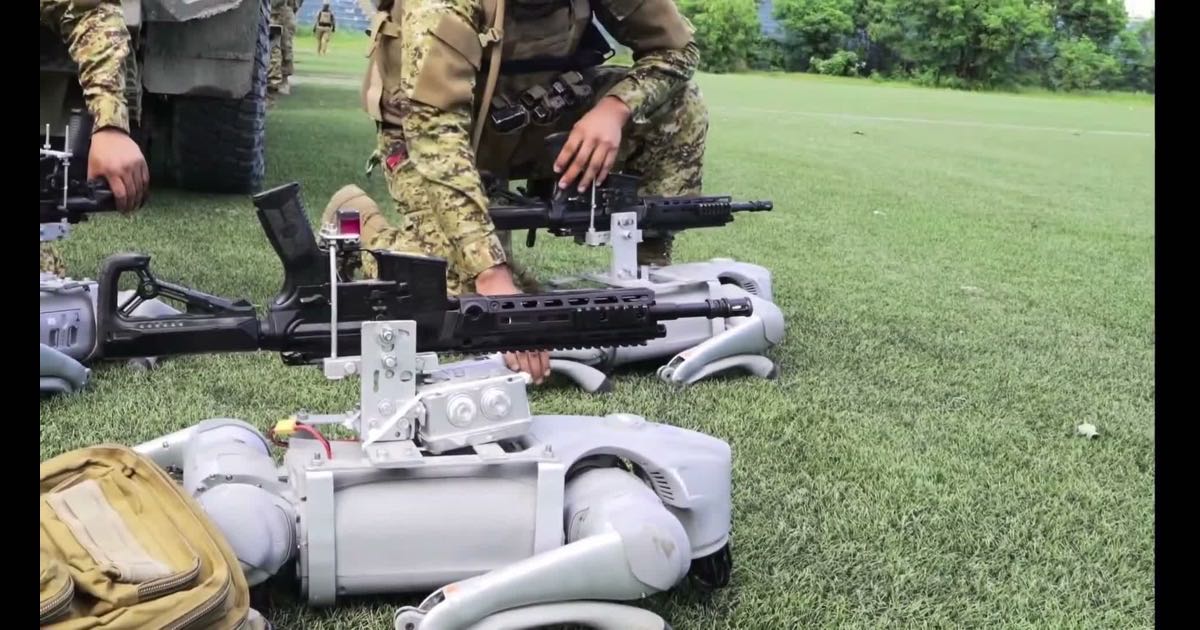
The video El Salvador’s president Nayib Bukele posted on X on Friday looks, at first glance, like an ordinary range day: soldiers in camouflage kneeling on grass, adjusting rifle mounts. Then the camera pans down. The rifles are bolted to grey quadrupeds — China-made Unitree Go2 robot dogs, the same $1,600-and-up consumer platform hobbyists program in their living rooms — parked on the pitch of Stade Sylvio Cator, Haiti’s national stadium in Port-au-Prince.
According to Al Jazeera, the operation retook the stadium from gangs that had controlled it for roughly two years; the Haitian and Salvadoran troops involved now intend to use it as a base for pushes deeper into gang-held territory. HaitiLibre reported that human skulls were found inside the stadium during the sweep. Bukele said as much himself: “We found several human skulls inside the stadium,” a claim that circulates via his own video and has not been independently confirmed by a second organisation — as of publication, no forensics report exists. OSINT accounts including war_noir identified the armament as Israel-made IWI ARAD-5 rifles mounted on the dogs; that detail, too, rests on open-source analysis rather than an official manifest.
The consumer-to-combat pipeline just got a live demonstration
Here is the part that should interest robotics people more than the geopolitics. Every component in these photos is documented: the platform is a Unitree Go2, a quadruped announced in mid-2023 and sold publicly from about US$1,600 for the base unit. The mounts are commercial. The rifles are export-grade. No defence contractor’s sealed prototype appears anywhere in the footage — and that is precisely the point. The barrier to arming a robot dog has stopped being “access to advanced hardware” and become “a 3D-printed mount, some hours of tuning, and soldiers to pull triggers remotely.”
The site has tracked this platform’s arc from novelty to problem child: Unitree’s own stage demo ended with a robot breaking a leg, its IPO surged 629 per cent on its Shanghai debut on the back of humanoid enthusiasm, and a Unitree G1 wandered and remembered a kitchen it had never seen in Stanford research. Those stories treated Unitree hardware as research and consumer tech. This week it is listed equipment in a foreign military operation, filmed by the president who ordered it.
It is not the world’s first armed robot dog — the US Marine Corps, China’s PLA, and others have paraded rifle-mounted quadrupeds before. What is new is the paper trail: a consumer company’s catalogue product, exported or purchased down a chain nobody controls, doing live security operations in a country under a UN-backed Gang Suppression Force mandate, while the deploying head of state markets the footage. Whether Unitree knew, approved, or even could know is not established by this footage; the company has not commented publicly as far as verifiable reporting shows.
The accountability gap is the story’s quiet centre
DW’s explainer on why El Salvador has troops in Haiti at all captures the legal fog: roughly 2,000 extra troops and special forces arrived in October, nominally to rescue four Salvadorans ambushed on 18 October and still missing, operating alongside a Gang Suppression Force whose coordination lines with national contingents are, in the words of CEPR’s Jake Johnston, “a huge concern about how this actually plays out.” Into that fog now walks hardware that costs less than a pickup truck, carries a rifle, and has no chain-of-custody paperwork beyond the government that deploys it.
For New Zealand readers the relevance is not the Caribbean. It is that the off-the-shelf lethalisation of consumer robotics has left the lab phase. The policy debates Wellington has had about export controls and autonomous weapons assume military programmes with state suppliers. The Go2 in Port-au-Prince undermines that assumption: export control, end-use monitoring, and platform-vendor liability were all designed for a world where arming a quadruped required an arsenal. That world ended this week, on video, on a football field. Nobody has yet written the rulebook for the one we now live in.
Sources: BBC Mundo (video), Al Jazeera, HaitiLibre, DW, Coffee & Covid (13 Nov 2026). Weapon-identification details are OSINT-derived and should be treated accordingly.
