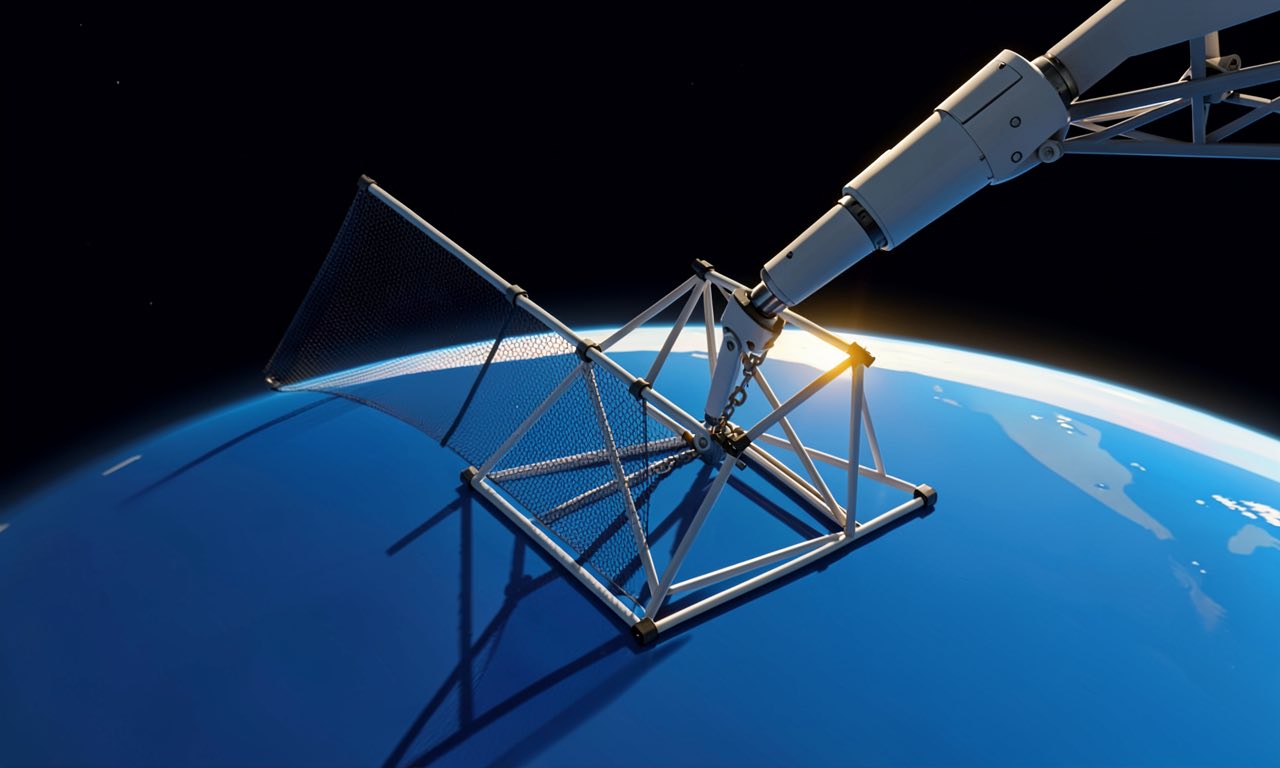
A robot has assembled a structure in orbit without any astronaut touching the hardware — a first in the history of spaceflight. The machine, called ASTRA and built by a Caltech team under Sergio Pellegrino, spent six months attached to an orbital vehicle working to build a 1.4-metre reflector antenna piece by piece. “This is the first time that a structure has been autonomously constructed in space,” Pellegrino said in Caltech’s announcement, published this month.
What the robot actually built — and the honest asterisks
ASTRA is roughly a cubic metre of gantry arm, motorised parts dispensers and 11 cameras, flying as one of 10 payloads on Momentus’ Vigoride 7 vehicle, itself launched on SpaceX’s Transporter-16 mission from Vandenberg Space Force Base on March 30, 2026. The robot’s job was repetitive and deliberately unglamorous: slide along three axes, pull composite fibre tubes and aluminium joints from storage dispensers, and join them into repeating “bays” — the structural sections of a larger antenna truss, topped with reflective mesh. DARPA, which funds the work under its NOM4D (Novel Orbital and Moon Manufacturing, Materials and Mass-efficient Design) program, compares the process to building with K’Nex or Tinkertoys.
Two full sections rode up pre-assembled inside the box; before doing anything, the robot’s first task in space was simply pushing them out. It then went on to assemble a third section on its own, per TechSpot’s breakdown of the mission. The finished antenna was supposed to take 11 such sections; the mission wraps up in December, so the team does not expect to complete the full 1.4-metre frame. Time limitations and scheduling constraints kept the team to the initial section, Caltech acknowledged.
The word “autonomous” deserves its own footnote, which New Atlas includes prominently: three team members on the ground sent commands and inspected progress through photos beamed down from orbit, and when something went wrong they first recreated the fault on an identical Earth-side copy of the machine before transmitting a fix. The robot handled the physical assembly — the hands-free part is what is genuinely new.
Why in-orbit assembly changes what a rocket can carry
The physical limit that has shaped six decades of space hardware is the rocket fairing: no telescope mirror or antenna surface can exceed the width of the nose cone it launches inside. Engineers have coped in two ways — fold structures up like origami and deploy them in orbit, or fly astronauts up to bolt pieces together. Both approaches cap the size, and both impose their own failure modes. Webb’s 21-foot mirror, as TechSpot notes, had to be folded to fit its launcher.
Robotic assembly is the third path: ship raw materials, and manufacture the structure where it will live. DARPA started NOM4D in 2022 with the goal to ultimately “ferry raw materials from Earth for in-orbit manufacturing,” and ASTRA is one of only two projects selected for the programme’s third, in-orbit demonstration phase. “NOM4D’s objective is to enable efficient, scalable construction of very large structures in space,” DARPA program manager Andrew Detor said in a statement carried by Caltech — and by “very large” he means “hundreds of metres or kilometers in scale.”
The applications run through astronomy, communications and space-based solar power — the Space Solar Power Project, which Pellegrino co-directs, aims to harvest solar energy in orbit and beam it to Earth, and its collector surfaces are exactly the kind of structure that cannot fit inside any fairing. There is a ghost in this story too: NASA’s OSAM-1 mission, which sought something similar with a robotic antenna assembler, was cancelled in 2024 after consuming $1.5 billion. ASTRA’s team went from design to orbit in roughly two and a half years.
The robotics story underneath the space story
The breakthrough that matters here for robotics on Earth is deceptively simple. ASTRA contains “no complicated robotics or advanced algorithms,” as the team puts it — just solid engineering: a repetitive assembly sequence, tolerant of error, executed far from any repair shop. That inverts the usual space-robotics pattern of the heroic manipulator. Canadarm2 assembled pieces of the International Space Station, but the components it moved were manufactured on the ground; the station’s 2014-era 3D printers proved you could make parts in orbit, but only small ones. Combining them — a general-purpose builder that takes commodities and produces structures — is the new territory.
Watch how this pairs with the commercial side of the orbital buildout. Google’s Sun Catcher project plans to fly TPUs on satellites, and an earlier wave of startups pitched orbital compute clusters — giant data centres in space that need exactly the enormous antenna surfaces and support trusses ASTRA’s technique produces. Caltech has already put an AI model in orbit aboard the ISS. Compute in orbit is a plausible market only if someone learns to build big structures up there without astronauts, which is precisely what NOM4D is for.
The realistic read: three sections of one antenna in six months, with a December end-of-mission, is a demonstration of feasibility, not a factory. But feasibility was the entire question. Every large structure humanity has ever put in space was launched whole or assembled by hand; one now exists that was neither. The second question — scale, and whether the K’Nex approach truly extends to hundreds of metres — is what NOM4D’s next phase and ASTRA’s successors will try to answer.
ScienceDaily also carried the university release with the full Pellegrino quotes.
Sources: Caltech, TechSpot, New Atlas, ScienceDaily