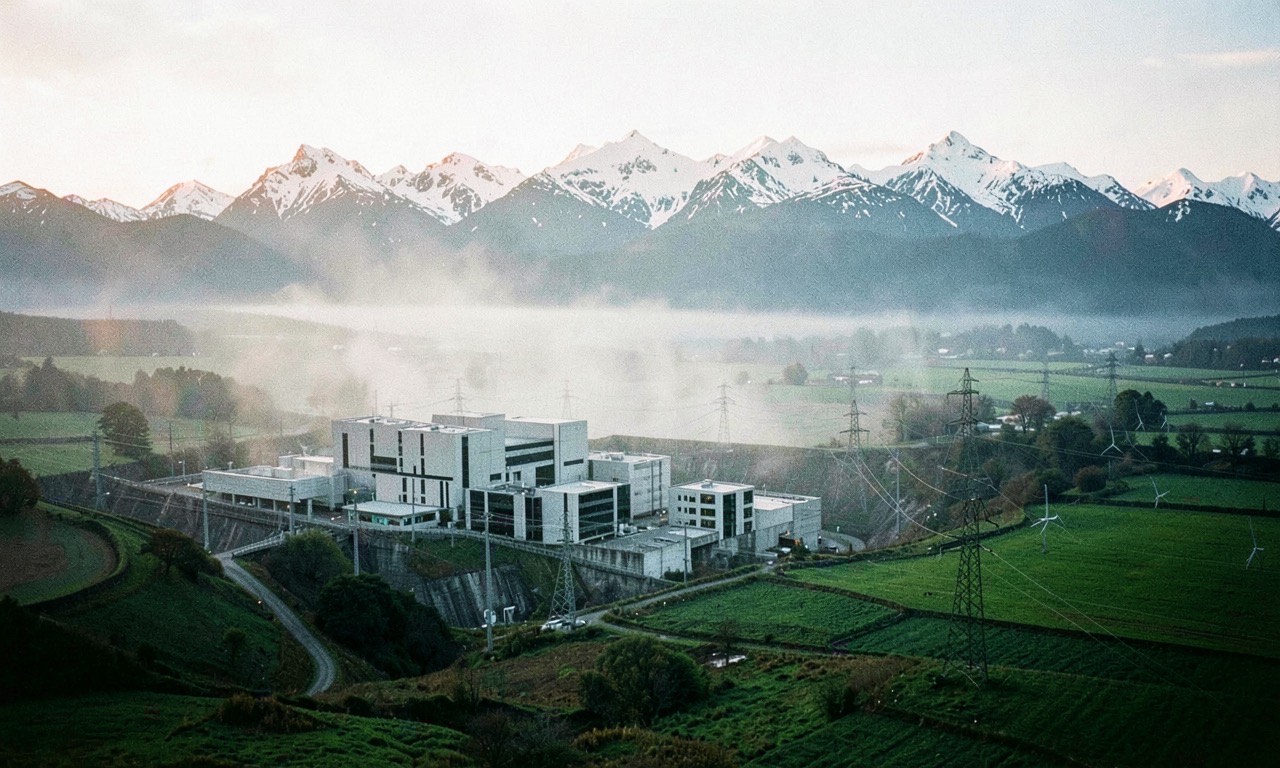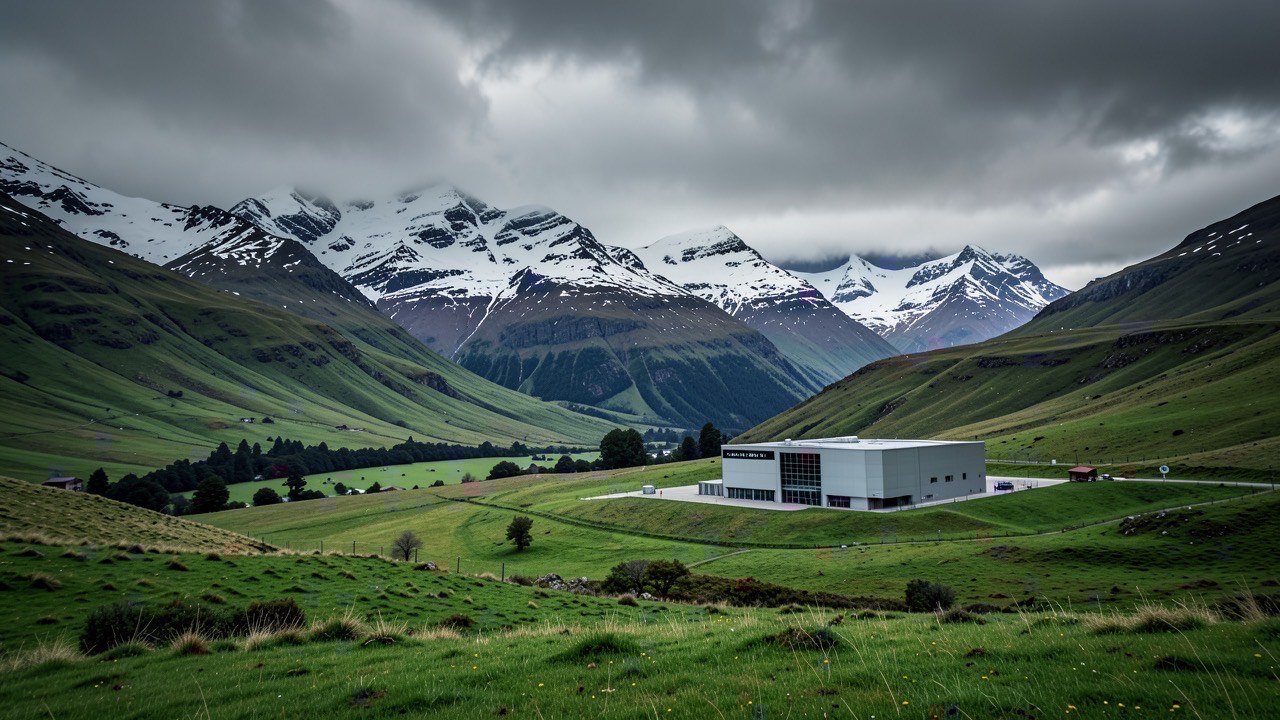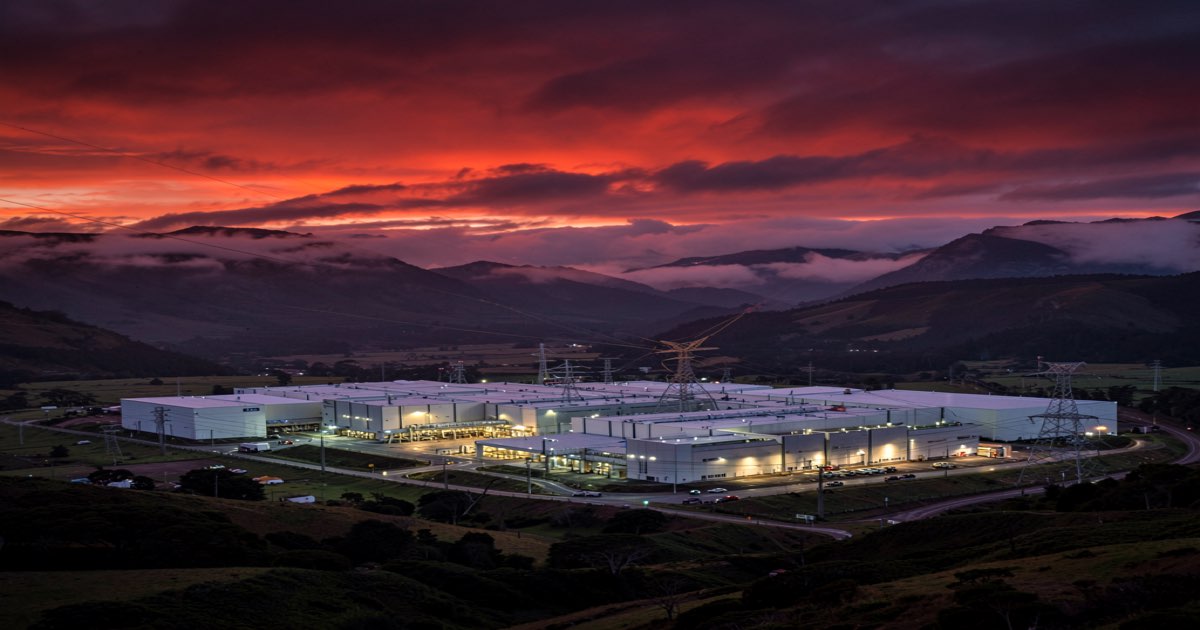
A data centre planned for Southland would become New Zealand’s second-largest consumer of electricity — behind only the Tiwai Point aluminium smelter — and the economics of what it returns to the country are staggering. Not in a good way.
Datagrid NZ’s proposed facility near Makarewa, north of Invercargill, would draw a continuous 280 megawatts. That’s about 6% of everything New Zealand’s grid currently produces. The project holds resource consent, and in July 2026, NZX-listed energy company Mercury confirmed a US$30 million ($53 million NZD) investment for a 12.7% stake.
Mercury also signed a 140MW power purchase agreement with Datagrid in March. Mercury’s CEO Stew Hamilton was appointed to the Datagrid board.
The Numbers
The figures come from Datagrid’s own consent application and analysis by energy commentator Larry Blair, who writes the essential New Zealand Energy Substack.
Power consumption: 280MW continuous, scaling to a potential 360MW at full build-out. That’s roughly 2.45 terawatt-hours of electricity per year — about half the output of the Manapōuri hydro station, which currently powers Tiwai Point.
Economic return: Datagrid’s own estimate puts the project’s annual GDP contribution at $60 million. Against 2.45 TWh of electricity consumed, that works out to approximately $24 of GDP per megawatt-hour.
Tiwai Point, by comparison, generates around $105 of GDP per MWh.
The productivity gap is stark. MBIE’s own data on energy intensity per dollar of GDP across New Zealand industries reads like this:
- Fishing and forestry: 2 MJ per $1 of GDP
- General industry: 11.5 MJ per $1 of GDP
- Chemicals and metals: 12 MJ per $1 of GDP
- Datagrid data centre: 147 MJ per $1 of GDP
That’s 13 times less efficient than the chemicals and metals sector in terms of energy returned per dollar of economic value generated for New Zealand.
The Mercury Structure
The structure raises questions. Mercury is:
- A power generator — it produces electricity
- A retailer — it sells electricity to households and businesses
- A part-owner of its own biggest new customer — the 12.7% stake in Datagrid, with a 140MW power purchase agreement
Mercury is just over half-owned by the New Zealand government. The company framed the investment as “disciplined” and “aligned with our core strategy.” Mercury’s executive general manager wholesale, Tim Thompson, said it would “improve Mercury’s understanding of how large-scale artificial intelligence and data centre demand would develop in New Zealand.”
But the structure means a gentailer — one of the four vertically integrated companies that dominate both generation and retail in New Zealand — now has a financial stake in what may become the country’s least efficient large-scale electricity consumer. Critics, including NZ First, have argued that the gentailer structure allows companies to shift costs internally, favour their own retail arms, and shape wholesale prices in ways that deliver record profits alongside record power bills. NZ First has pushed to break up the gentailer complex, opposed by National and ACT.
Where Does the Power Come From?
New Zealand’s electricity consumption in 2024 was 1% lower than in 2014. High prices and demand management have driven a trend of deindustrialisation — industries closing or scaling back because power costs too much. Wattie’s has been cited as a recent example.
Into this environment, Datagrid arrives needing 280MW of continuous, uninterruptible power. Unlike Tiwai Point, which can negotiate potline closures during dry years and release power back to the grid, a data centre cannot power down without damaging its equipment. It runs 24 hours a day, 365 days a year.
The Manapōuri hydro station is the obvious source. It’s nearby, it’s renewable, and it has the capacity. But Manapōuri’s output is already committed to Tiwai. If both Tiwai and Datagrid are drawing from the same generation, a dry year — when hydro lakes are low — becomes a national energy security problem.
Datagrid has said it will build new generation. The generation investment pipeline shows roughly 2GW of capacity being pursued, mostly wind and solar. But wind and solar are intermittent. A 280MW continuous load cannot be reliably served by weather-dependent generation without firming — battery storage, hydro backup, or gas peakers. Solar panels will not keep a data centre running through a calm Southland night.
Foreign-Owned, NZ-Powered
The majority of Datagrid NZ is held by Singapore-based Datagroup Holdings (BW Digital). The founder and chair, Remi Galasso, is a French entrepreneur. The project was first proposed in 2020 by rich-lister Malcolm Dick and Galasso.
The value generated for Datagrid’s owners in Singapore would likely exceed the $60 million annual GDP contribution claimed for New Zealand. The data centre’s stated purpose is to serve international AI and cloud clients — not NZ businesses. The power is NZ’s. The compute is for export. The economic return to NZ Inc, on the numbers Datagrid itself has provided, is a fraction of what the same electricity would generate if allocated to existing industry.
The Opportunity Cost
Every megawatt-hour diverted to this data centre is a megawatt-hour not available to higher-value NZ industry. The grid is not infinite. New Zealand has limited electrons to spare, and the price of those electrons ultimately sets the quality of life.
If Datagrid draws 280MW, that power comes from somewhere. Either new generation gets built — which takes years and requires the same gentailers to invest — or existing industrial users get squeezed further. Both outcomes raise electricity prices for everyone else.
The $3-3.5 billion project will employ around 550 workers during construction. Once operational, it will require about 50 staff. The construction jobs are real but temporary. The ongoing employment footprint is smaller than a medium-sized factory.
This Is Not an Anti-Data-Centre Argument
Data centres are necessary infrastructure. AI training and inference require compute, and compute requires power. The question is not whether New Zealand should host data centres. The question is whether a single foreign-owned facility should consume 6% of the national grid while returning $24 of GDP per MWh, with a gentailer simultaneously owning the generator, the retailer, and a stake in the consumer.
New Zealand previously framed the Datagrid project as a carbon arbitrage opportunity — running AI on renewable NZ electricity instead of coal-powered grids elsewhere. That argument has merit. But it does not answer the energy security question, the gentailer conflict question, or the opportunity cost question.
The global backlash against data centres has been building. NZ has so far avoided the protests and arson seen in Ireland and the US. But the conditions that drive that backlash — communities feeling the cost of data centres while seeing little benefit — are present here. The difference is that in NZ, the cost is measured not in local noise and water usage but in national electricity prices.
What Needs to Happen
The final investment decision on Datagrid is expected later in 2026. Between now and then, three questions need answers:
1. Is $60 million in annual GDP accurate? If it is, the project’s energy intensity is 147 MJ per dollar of GDP — 13 times worse than the chemicals and metals sector. If it’s not, Datagrid needs to release the real number.
2. How will 280MW of continuous demand affect the wholesale market? Transpower needs to explain how this load integrates with a grid that is already struggling to deliver stable, affordable electricity to existing users.
3. Should a gentailer be allowed to own a stake in its own largest new customer? Should the Commerce Commission examine whether Mercury’s dual role as generator and Datagrid shareholder creates a potential conflict that could distort the market?
New Zealand’s energy security is not a hypothetical concern. It is one of the most important factors in the country’s economic future. If the analysis is right, the outcome could mean higher power prices, further deindustrialisation, and a grid increasingly strained by a facility whose primary value flows offshore.
Sources:
- NZ Herald — Mercury invests $53m in Southland Datagrid data centre project (July 23, 2026)
- RNZ — A new Southland datacentre would be the country’s second-largest drain on power (March 17, 2026)
- New Zealand Energy Substack — The 280MW question (March 18, 2026)
- Data Center Dynamics — Datagrid signs power supply deal with Mercury
- Datagrid NZ — Resource consent announcement (March 2026)
- Holyhekatuiteka on X (July 27, 2026)
Related:
- NZ’s AI Data Centre Isn’t Just Infrastructure — It’s Carbon Arbitrage
- When Data Centers Become Targets — Could NZ Become the World’s AI Safe Haven?
- Big Tech Climate Goals Wrecked by AI Energy Demand
- Aschenbrenner: The Power Bottleneck
— CJ Murden, editor of Singularity.Kiwi. Former digital technologies teacher, author of AI-focused books. Writing with a New Zealand focus.