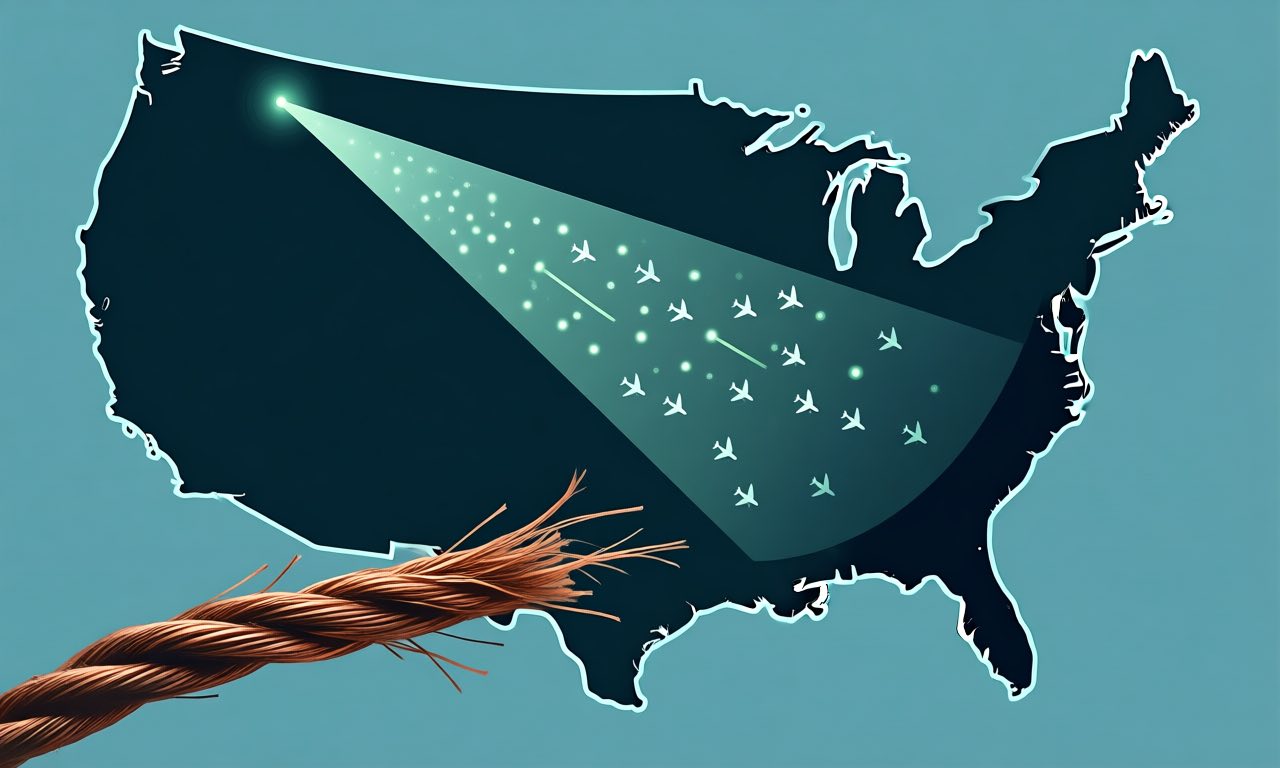
At 3:54 p.m. Eastern on Friday, the Federal Aviation Administration did something it has done only three times in US history: it ordered every departing flight in the country to hold on the ground. The reason, per the agency, was an “extraordinary” communication and radar instability across air route traffic control centers. Four hours and 21 minutes later the ground stop lifted, leaving thousands of cancelled flights, stranded sports teams, and a very inconvenient question doing the rounds online.
The inconvenient part: the stop came four days after the FAA announced it had expanded SMART — a cloud-based, $875 million AI system from Air Space Intelligence that predicts traffic flows and recommends reroutes — from a handful of regions to all 22 of the country’s air route traffic control centers, as Ars Technica detailed.
Officials lined up fast to separate the two events. Transportation Secretary Sean Duffy told reporters the failures were in “all the old legacy equipment,” and that “all of the new equipment that’s been deployed did not go down.” The White House briefing pointed at antiquated telecom hardware overloading under new technology being installed around it; Homeland Security Secretary Markwayne Mullin said there were no “footprints” of a cyberattack and nothing to suggest a “rogue artificial intelligence incident.” Air Space Intelligence, the company behind SMART, denied any connection on social media the same day. The FAA says SMART isn’t even wired into the systems that failed — it advises controllers, it doesn’t control radar or radios.
What SMART actually is — and isn’t
According to the FAA’s fact sheet, the Strategic Management of Airspace, Routes and Trajectories system ingests airline schedules, weather, airport capacity and controller staffing to predict congestion and recommend reroutes before conflicts happen. It has been live in the Washington, DC airspace since September 21, where the FAA credits it with rerouting 180 flights, saving an average of 10 minutes and roughly 80 gallons of fuel per rerouted flight. The agency announced the national rollout to 22 centers on November 10.
Critically, a human team of FAA specialists validates every SMART recommendation before it reaches controllers, and local facilities decide whether to take the advice. The FAA’s own September announcement stressed that the system “cannot be used to replace the critical role air traffic controllers play or take over control of an aircraft.”
That nuance did not stop the internet from doing what it does. “Did the new AI crash the airspace” was trending within hours, and outlets from Gizmodo to Futurism ran with versions of the question. The timing really is a coincidence — but the fact that so many people found the AI-caused version plausible is the story now, as Mashable noted when weighing the claims against the official denials.
The unions never signed off on this
The loudest structural criticism predates the ground stop entirely. The National Air Traffic Controllers Association, which represents more than 15,000 controllers, told Flying magazine it “was not consulted or involved in the design, testing, or implementation of SMART” and therefore could not speak to its effect on the workforce. Airline executives, by contrast, cheered the deployment — Delta’s Ed Bastian and American’s Robert Isom both provided supportive statements for the rollout announcement.
A 12-year, $875 million contract awarded to Air Space Intelligence in June is the generational bet — the company’s software already runs live operations for major US airlines and the Air Force, per ASI’s own announcement. Duffy is now using the outage to push Congress for $30 billion more to finish replacing the wiring underneath everything, on top of the $12.5 billion approved last year.
The actual lesson for AI in government
Two true things sit side by side here. First: a decades-old copper telecom infrastructure finally buckled, exactly the way safety experts like former United pilot Steve Arroyo warned — if controllers can’t reliably talk to pilots, you stop airplanes on the ground. Second: the most advanced AI decision-support system in the agency’s history had just been switched on nationwide, four days earlier, atop that same crumbling substrate.
For anyone deploying AI in critical infrastructure, Friday was a free preview of the next decade’s core political problem. The AI layer is the easy part to explain and the hard part to trust; the boring legacy layer is the part that actually fails. When they touch the same system on the same day, the public will not parse the subsystem boundaries — and every operator of AI-assisted critical systems, from grid operators to whoever runs air traffic control in this part of the world, will spend the incident doing what the FAA did Friday night: proving a negative about software that never touched the thing that broke.
It is also a lesson in sequencing that NZ agencies should note as AI decision-support creeps into infrastructure here, following moves like the EU’s first enforcement actions over agentic AI incidents and the US push to wire AI into everything from air traffic advice to military logistics. The FAA got the order right — advisories from AI, humans validating, legacy systems replaced underneath. Getting the order right doesn’t stop the headlines when the legacy layer collapses the same week. It just decides whether the AI gets the blame, or the budget.