A person can walk into an unfamiliar home and start working immediately. They don’t need to relearn how to make a bed because this one is a different height, or how to fold a towel because the laundry is in a different room. Robots, until very recently, learned the places they worked in one place at a time.
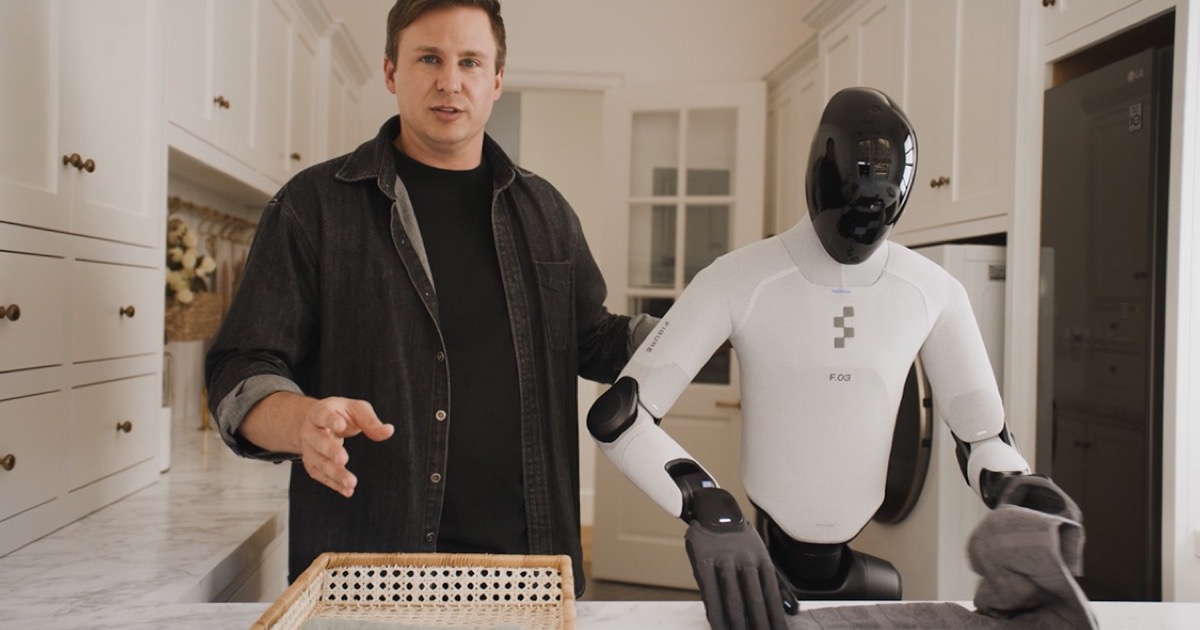
On Thursday, Figure AI announced Helix 2.5, the neural network it calls the most advanced it has built — and the first evidence, in its telling, that this wall is coming down. Per Figure’s announcement, Helix 2.5 performed three whole-body tasks — tidying living rooms, folding towels, making beds — across 30 Bay Area homes with zero data collected in any of them. No fine-tuning. No adaptation period. No prior exposure to the homes or the objects inside them.
The number that matters
The flashy part of the announcement is the 30 homes. The number that actually tells you something is smaller and less comfortable to look at.
Figure trained two policies on identical task-specification data, with architecture, optimisation, hyperparameters and evaluation held fixed. One started from random weights. The other was initialised from Helix 2.5 pretrained on Index, Figure’s large-scale dataset of human behaviour video. The random-init policy succeeded zero-shot 9% of the time. The Index-pretrained one managed 56% — and Figure grades without partial credit: every toy picked up, every towel folded end-to-end, the whole bed made, with 1–3 minute timeouts and any human intervention counted as a failure.
That is the entire difference between a robot that basically cannot work an unfamiliar home and one that usually can, and none of it came from practising in those homes. It came from pretraining on video of humans doing things. Figure also reports a “human-to-humanoid transfer scaling law”: repeatedly doubling Index pretraining data improved downstream robot-action prediction smoothly enough that the company says it forecast its largest run’s loss to four decimal places before training began. If that smoothness holds at further scale, the practical ceiling here is set by how much human video Figure can gather — which is exactly what its crowdsourced data pipeline is for. We covered that dataset build-out in August, and it’s worth noting how quickly the “we have a big pile of human video” story turned into a “the pile improved the robot six-fold” story.
Why whole-body is the hard part
The task selection is deliberate. Tidying a room, folding a towel and making a bed each combine perception, locomotion, bimanual coordination and deformable-object manipulation. A tabletop arm never has to walk anywhere; a wheeled robot needs open floor to turn. A humanoid in a real house has to position its whole body to see, reach and manipulate in tight, cluttered spaces that were designed for people, not machines. Figure’s argument is that homes offer no accommodation to the robot, so the control problem can’t be decomposed into separate perception and locomotion modules — it has to be solved whole.
This is also a step change from Figure’s own Helix 02 generation, which showed impressive whole-body coordination — dishwasher unloading, 200-hour autonomous logistics runs — but learned from data collected where the robots would actually operate. Helix 2.5 matched Helix 02’s success rate, Figure says, while using half as much task-specification data and generalising that behaviour across 30 unseen homes: 2x cheaper to specify, 30x wider in scope. (The same Figure 03 hardware is now climbing ladders on its own, as we covered earlier this month.)
Read the fine print
Three caveats belong next to the headline numbers, and Figure’s own write-up provides them.
First, 56% success also means the robot failed end-to-end 44% of the time in these trials. That is a genuinely strong result for zero-shot whole-body autonomy — it is also nowhere near a product you’d let loose in your house unsupervised. Second, the evaluations were designed and graded by Figure itself; “to our knowledge, this is the first demonstration of zero-shot whole-body generalization at this scope on a humanoid” is the company’s claim about its own work, not an independent benchmark. Third, three tasks across 30 homes is a narrow slice of what “general housework” means. Laundry folding is not cleaning a bathroom is not cooking dinner.
Figure’s own closing framing is unusually honest on this point: the point is not that general humanoid robotics is solved, the company writes — but Helix 2.5 is the first evidence that whole-body intelligence can be learned from human experience and transferred to new scenarios, rather than rebuilt each time.
That framing seems right. The interesting question was never whether a humanoid can be trained to work one specific home — that was already being done, expensively, one house at a time. The interesting question is whether the training curve bends toward “works anywhere,” and for the first time there is a measurable answer pointing yes.