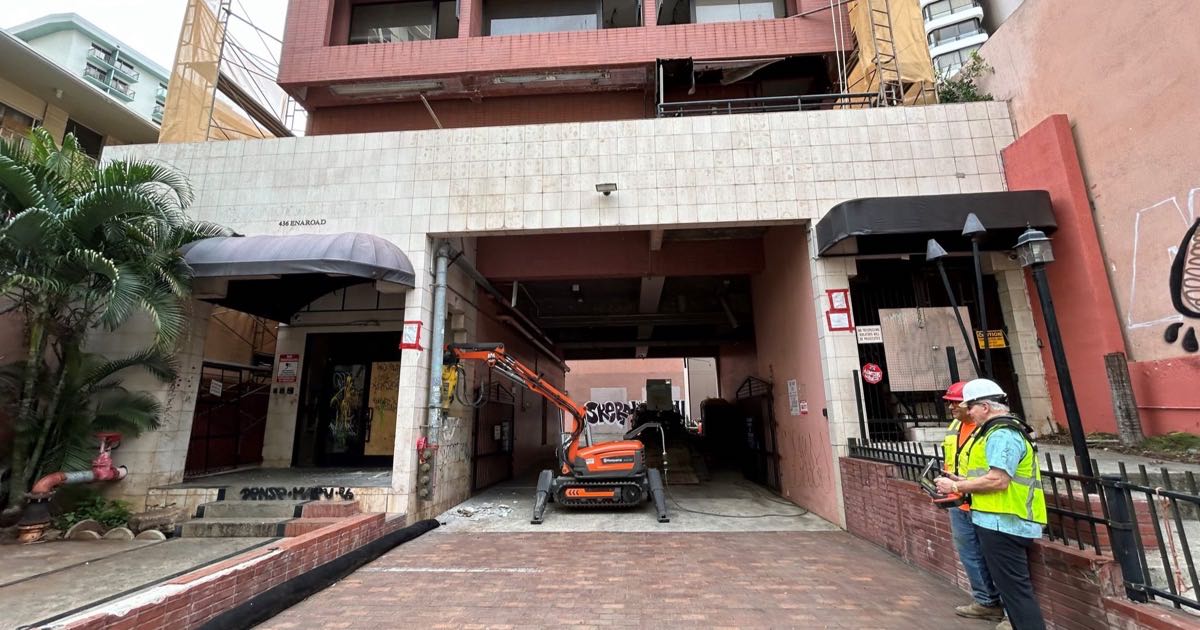
The machines that tear down buildings usually get described in tons and reach. Honolulu’s newest demolition crew gets described in square metres instead, because that is all the site left them. On Friday the city showed off a small, remotely operated demolition robot at 436 Ena Road in Waikīkī, where crews have begun dismantling the vacant eight-storey, 33-unit former Ena Motoi building to clear ground for affordable housing. Aloha State Daily reported that the robot is made by Husqvarna — the Swedish company better known for chainsaws — and that mayor Rick Blangiardi worked the controller himself for the first swipes. “Using robotics is really incredible,” he said. “One more step, one more new dimension when we talk about modernizing the city.”
The interesting part is not the robot. It is the elevator shaft. Kevin Auger, director of the city’s Department of Housing and Land Management, told Hawaii News Now why the machines go up on the roof and work downward: the debris gets loaded into the shaft and dropped through the middle of the building. “We don’t have room here for large trucks. We don’t have room here for a large crane. So that was an extraordinary solution,” he said. Waikīkī density turns the conventional demolition sequence — big excavator, long-reach arm, a queue of haul trucks — into a physical impossibility, so the city is running the job through a machine roughly the size of a ride-on mower.
What the robots are actually doing
This is teleoperation, not autonomy — an operator with a controller working from a safer distance, which the city framed as a worker-safety gain on a cramped site between occupied buildings. The robot at Friday’s showcase is a compact tracked machine with an articulating arm, the type Husqvarna sells for breaking concrete and tearing out interiors in spaces too tight or too hazardous to walk a full-size excavator into. Per the reports, structural demolition by contractor R.H.S. Lee Inc. begins the week of November 2 and runs through February 2027, with the robots going up through the elevator shafts and demolishing from the roof down.
The building itself has been waiting a decade for this. Hawaii Free Press notes the city acquired the roughly 6,000-square-foot property in 2018 with federal Community Development Block Grant money, and the site’s redevelopment has detoured more than once — an EAH Housing/Core Tech partnership from 2025 has since dissolved, and the redevelopment will be rebid, with a request for qualifications due by the end of the year. Demolition is the part the city can actually control while it sorts out a new builder.
The quiet infrastructure story
There is a pattern here that has little to do with Hawaii. The visible robotics story of 2026 has been humanoids — and it is easy to conclude, watching the demos, that the industry’s answer to every task is a five-foot-tall generalist. The bricklaying robots setting walls on Australian sites, the robotics-as-a-service home framing sold to an American builder, the hundreds of millions flowing at construction-robotics startups — that money is largely chasing machines that imitate the human form. Meanwhile the machines quietly racking up real jobs are boring, purpose-built, remote-operated units like this one, doing work at a scale humanoid trials do not yet touch.
The honest version is less romantic than either extreme: the machine that wins a job site is the one that fits it, not the one that looks most like us. A Waikīkī block had no room for a crane and a queue of trucks, so the winning design was something small enough to ride an elevator and dumb enough to be controlled by a person standing safely behind a fence. That constraint-driven selection is happening all over the industry, and it will decide which form factors are actually working in ten years. A mayor driving the first swipes for the cameras is a photo op; a robot that fits the elevator shaft is the actual infrastructure story. If construction robotics is going to matter at city scale, it will be through deployments exactly like this — unglamorous, contractually mundane, and judged by whether the building comes down on schedule in February.
As of publication, none of the reporting outlets indicates any local opposition to the robotic demolition plan; work begins this week and runs through February 2027.
Sources: Aloha State Daily, Hawaii News Now, Hoodline, Hawaii Free Press. Photo: Hawaii Free Press.