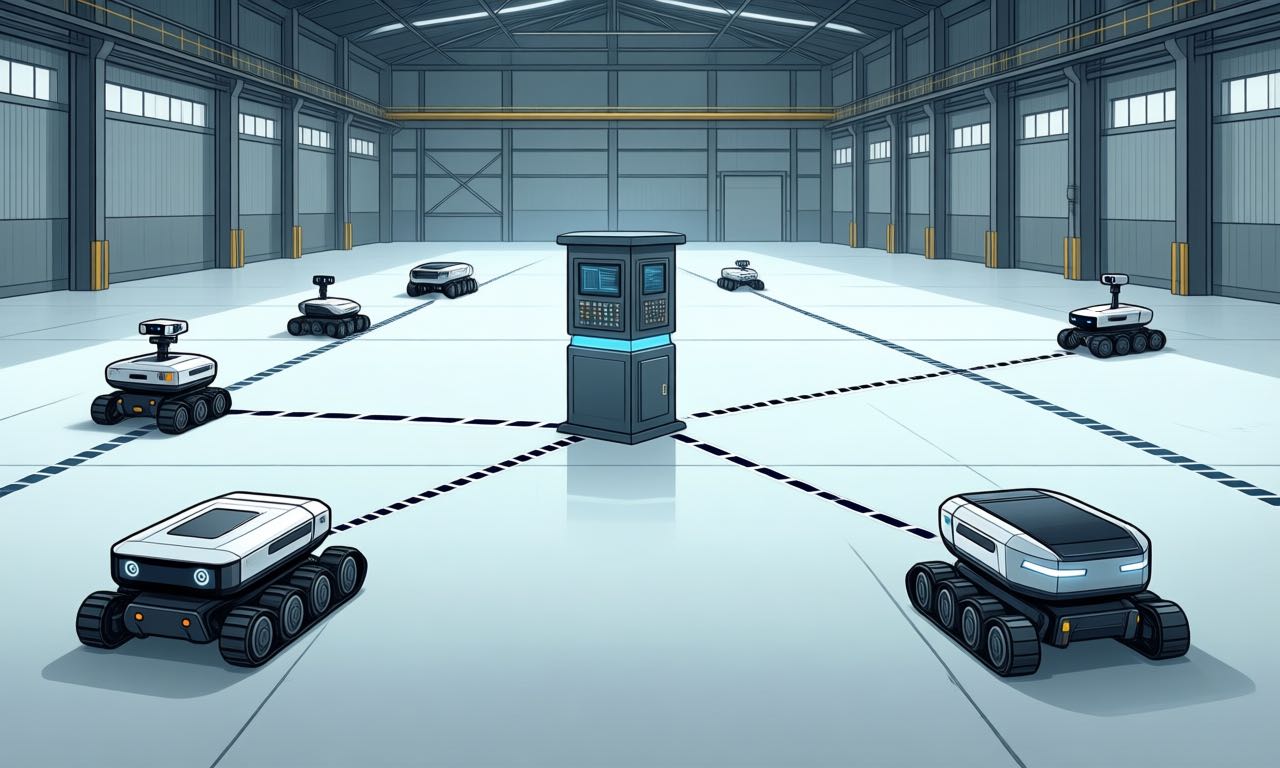
Standards rarely make headlines, but ISO 21423:2026 deserves an exception. Published 13 October 2026 by ISO Technical Committee 299 and announced this week by A3 — the Association for Advancing Automation — it defines how industrial mobile robots (IMRs) from different vendors talk to each other on a shared factory or warehouse floor. Per The Robot Report, the standard covers both robot-to-robot and robot-to-fleet-manager communication: AGVs, AMRs and similar systems exchange location, speed, direction, condition, tasking and availability. It reaches beyond the robots themselves, covering communication with machines robots tend, enterprise resource planning tools, and building systems such as lifts, automated doors and alarms.
“Companies want to choose the robots that fit their applications and have those robots work together on the same floor,” said Carole Franklin, A3’s director of standards development for robotics. “Many leading industrial users of mobile robots have asked for an interoperability standard for years.” It is the first non-safety robot standard A3 has helped produce — available from the A3 online store at $373 ($320 for members).
Why this is the quiet kind of important. Walk any large fulfilment centre today and you will find robots from different vendors that cannot see each other. One fleet’s autonomous forklift meets another vendor’s pallet mover at an intersection; one freezes, the other re-plans, and a human supervisor untangles the standoff. Aaron Prather, a robotics standards researcher who has followed ISO 21423 through development, describes the pre-standard reality plainly: mobile robots from different manufacturers are “designed with their own logic for navigation, safety and communication,” and in practice systems “frequently stumble when they encounter one another, creating costly bottlenecks and forcing humans to intervene.” The standard does not solve navigation — navigation requirements are explicitly out of scope, and the document states it carries no safety requirements. What it standardises is the conversation: who is where, how fast, doing what, and available for what.
Built on familiar foundations, deliberately. ISO 21423 leans on two proven precursors rather than inventing a new protocol layer: the MassRobotics AMR interoperability standard, already piloted in North America, and VDA 5050, the European AGV communication interface built around MQTT and JSON. The difference is reach: VDA 5050 assumes a centralised fleet manager directing every robot, while ISO 21423 also supports distributed, peer-to-peer exchanges. Prather’s account of the process notes nearly 90 participants from France, the US, Germany, Japan, Korea, Singapore and India, including end users like General Motors and Procter & Gamble — a breadth that matters, because a standard no end user adopts is a PDF, not infrastructure.
Vendors have been positioning for this publication for a while — InOrbit shipped a reference implementation of the then-draft standard and opened its fleet operations core back in September. With the text now final, those early implementations move from “betting on a draft” to “first movers on a published standard” — the usual standards-cycle reversal, where the vendors who looked early become overnight incumbents.
The NZ and mid-size operator angle. For the vast majority of warehouse operators — everyone below Amazon-scale — the interoperability tax has been a real deployment barrier: buy one vendor’s ecosystem or pay integration costs to stitch fleets together. A common protocol shifts purchasing power to the buyer. A site can keep a proven vendor for one workflow and add a different robot for another without an integration project, and fleet software built on VDA 5050-style semantics can span both. For NZ logistics operators watching multi-vendor fleet deployments like the RichTech Titan systems shown at IMTS, this is the standards layer those deployments quietly assumed. Universal Robots’ Gen7 physical AI platform shows where the vendors are heading — the standard gives mixed fleets a way to get there without single-vendor lock-in.
As of publication, the A3 announcement and The Robot Report’s write-up are the news coverage; independent reporting on the standard’s publication has not yet appeared elsewhere (catalog listings confirm its published status). The measure of ISO 21423 will not be its announcement but its adoption curve — watch for vendors declaring compliance in product releases through 2027. Standards like this one succeed when they become invisible: robots from different makers that simply don’t crash into each other.
Sources: The Robot Report · iTeh — ISO 21423:2026 catalog entry · Aaron Prather, Six Degrees of Robotics