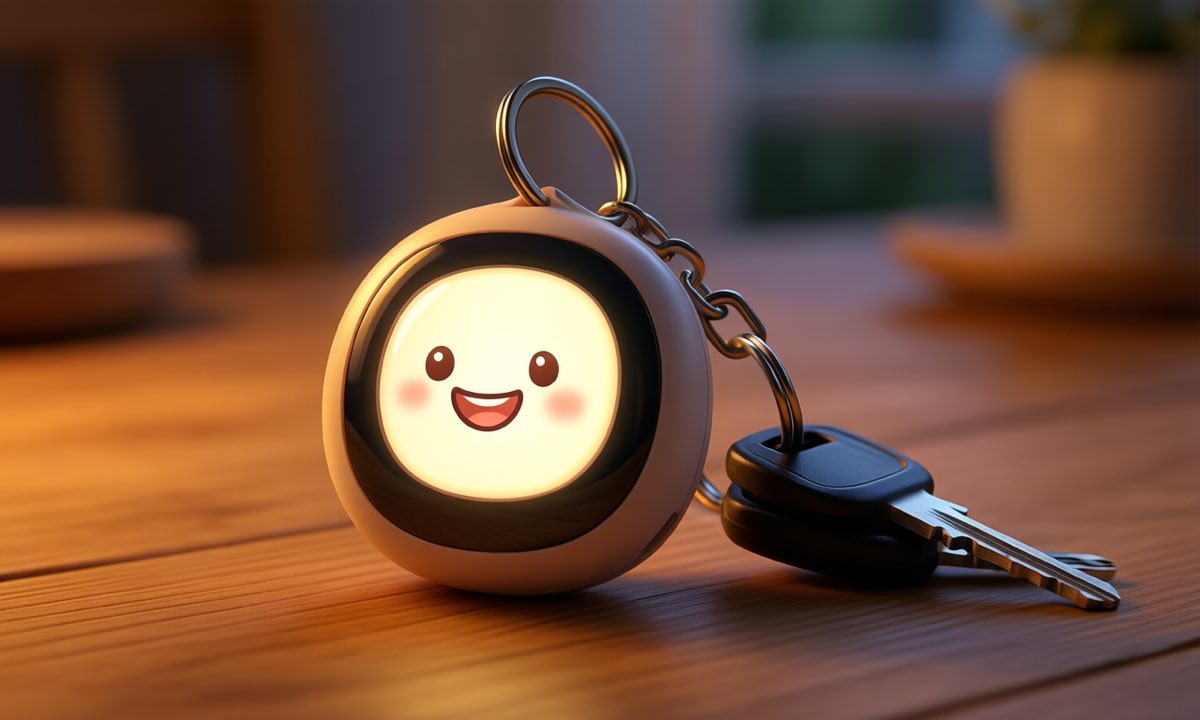
At Meta’s Connect event on September 23, Mark Zuckerberg used his “one more thing” slot to reveal the Muse Charm — a palm-sized device that carries the entire Muse experience, keychain included, with a launch window of “in time for the holidays in December.”
What the Charm actually does
The device is small, has a tiny screen, and displays the cartoon avatar — known inside Meta as Jolly — that embodies the Muse agent. Zuckerberg’s on-stage demo made the pitch concrete:
“We packed the whole Muse experience, including the whole real-time voice and avatar stack, into something that fits on a keychain and is always available to talk to. You just go ahead and tap here in the fingerprint sensor in the corner, and you can start talking without having to unlock a phone or open an app.”
His framing for why it matters: “So if you’re not wearing glasses, this is going to be by far the fastest way to talk to your Muse and to show what’s going on around you.”
That voice-and-avatar stack is worth pausing on, because it connects to the quiet software achievement underneath. Meta’s Muse Glimmer is a 30-billion-parameter model built to run agents locally — on an ordinary laptop with a single consumer GPU, released under Apache 2.0 and free for commercial use. Compressing an agent stack to the point where its interface fits on a keychain is the same engineering instinct that produced Glimmer: make the AI small enough to be everywhere. Bloomberg reports the Charm will carry its own 5G modem so it can reach Muse without Wi-Fi, with a two-inch OLED screen, cameras, speakers and a fingerprint sensor — and is expected to cost about as much as a smartwatch.
A company willing to look silly
The Charm is another front door to Muse, the personal AI agent Meta launched recently to what TechCrunch reports is faster early mobile adoption than ChatGPT managed. The software side of the empire we’ve tracked closely: the free-agent strategy with the meter running in the background, and the shopping-agent friction with Amazon.
The obvious context is the graveyard — the AI Pin, the Rabbit, the Friend pendant all promised ambient AI hardware and didn’t stick. TechCrunch’s follow-up on September 24 framed the split neatly: is the Charm a playful device that makes AI approachable, or “yet another flop in a long list of AI hardware gadgets that didn’t take off”? Early reactions, per the report: mixed.
But there’s a better way to read what Meta is doing here. The graveyard is full of startups that bet the company on one gadget and died with it. Meta is a company with a live agent, billions of existing users, and the resources to try again — and it is trying, deliberately, in the most unfashionable-looking form factor it could find. The Charm leans into a Gen Z aesthetic — the dangling bag-charm wave that turned Labubu toys and charm-clad water bottles into accessories, and more recently the Apple Watch-as-keychain trend popular with younger women on TikTok — rather than fighting it like the tech-first AI Pin did.
There’s a real thesis underneath the cuteness. The AI Pin failed partly because it demanded you take technology seriously; the Charm works only if you don’t. A device you’re meant to talk to constantly needs to be something people actually enjoy carrying, and fashion — not spec sheets — is what decides that. Meta has watched young people drift toward touchable, personal tech (flip phones, digital cameras, charm-clad watches) and away from feeds that feel samey and soulless, and built a product for that drift instead of against it. The translucent “elevated hacker aesthetic” Zuckerberg teased on stage says the same thing: this is a company that knows its last several hardware swings missed, and is swinging differently instead of swinging safer.
The one concrete hedge on Meta’s side: the hardware isn’t finished. Zuckerberg said the team still had to “finalize laying out the components,” which is why December is a promise and not a launch date — only a few units exist so far. When it ships, the test is simple: whether Meta has made the first AI device people carry because they want to, not because a keynote told them to. On the evidence of this launch — a playful form, an open 30B model behind it, and a company unafraid to try again — it has at least learned what the graveyard victims never did.
📰 Sources
- TechCrunch — Meta made a Tamagotchi-like wearable for its Muse AI agent
- TechCrunch — Meta’s Muse Charm looks like a Tamagotchi, but it’s tapping into a much newer trend
- The Verge — Meta is making a standalone Muse AI gadget
- The Verge — Meta’s Muse AI Charms can interact with each other
- Singularity.Kiwi — Meta’s Muse Glimmer 30B: the agent model that runs on your laptop
— CJ Murden, editor of Singularity.Kiwi. Former digital technologies teacher, author of AI-focused books. Writing with a New Zealand focus.