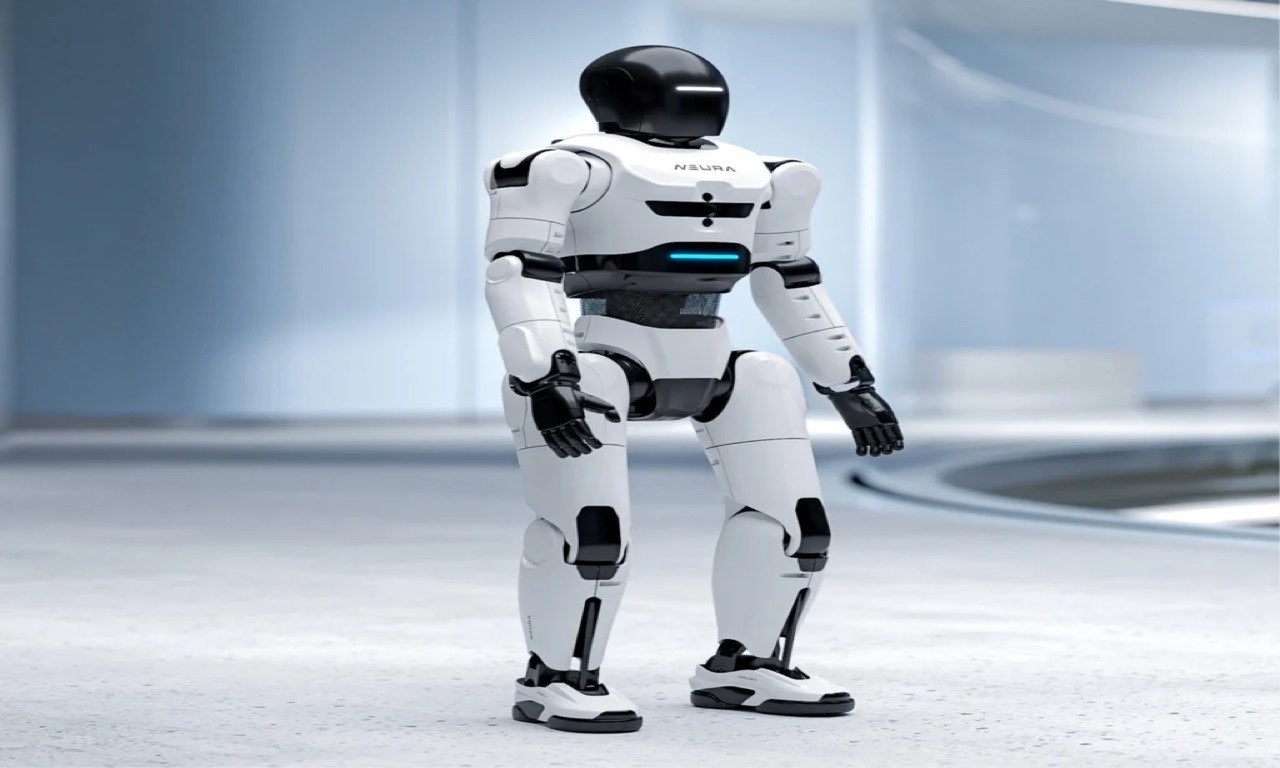
NEURA Robotics
Europe's answer to the humanoid race. Cognitive robotics that think before they act.
Key Specs
At a glance.
Latest Developments
Where the company stands in 2026.
NEURA partnered with energy giants E.ON and the enviaM Group to develop robots for electricity-grid operations — inspections, critical-asset monitoring and worker support at substations, with enviaM's MITNETZ STROM as pilot partner and initial field trials expected in 2027, per E.ON's announcement and Humanoids Daily. Training runs through TUM RoboGym; no fleet size or rollout targets disclosed.
More detail on the Gen 4 reveal: NEURA says the new 4NE1 is 20% lighter than its predecessor, wrapped in black textile, with upgraded gripping hands and "Smart Limbs" that carry local limb-level reflexes responding in milliseconds instead of routing everything through the main brain, per Humanoids Daily, Interesting Engineering and Tech Times. It's being prepped for series production with no price or delivery dates yet, and a separate NXAI partnership is targeting stronger memory for multi-step tasks in NEURA's software stack.
NEURA and TU Munich opened the TUM RoboGym at Munich Airport's LabCampus — one of Europe's largest embodied-AI training centres, with ~100 humanoid and service robots across 48 training cells feeding a curated cloud data lake — and used the opening to unveil the 4NE1 Gen 4, "designed for series production, built for productive work and powered by Neuron AI," per TUM's release and Robotics Tomorrow. Bavaria's deputy minister-president and science minister both framed it as a bet on Germany's physical-AI industrial base.
NEURA introduced Neuron AI — its multimodal foundation model for Physical AI, combining 3D vision, touch, audio, robot state and language with memory, so robots can act on context beyond the camera view, per EU-Startups and NEURA's release. The company will show its 4NE-1 humanoid at NVIDIA GTC Berlin performing an 11-minute laundry-handling sequence on the current model. Funding backdrop unchanged: up to $1.4B Series C (Jun 2026) at ~$7B valuation with Amazon and Nvidia among backers.
NEURA launched NEURA HealthTech, a dedicated healthcare and life-sciences unit — first application is an autonomous platform that moves empty hospital beds, with the wheeled assistant MiPA being trained for patient-room and medication support, per NEURA's announcement and Humanoids Daily. No role announced yet for the bipedal 4NE-1.
Partnered with Italian embedded-computing firm SECO to design and build the compute modules for its cognitive robots, including 4NE-1 — modules produced in Europe, running Qualcomm Dragonwing processors, according to The Next Web. NEURA targets "millions of cognitive robots by 2030".
Acquired ADLATUS Robotics, an Ulm-based autonomous commercial-cleaning robot maker with hundreds of installed systems — NEURA's fifth acquisition in 16 months as it assembles a Physical AI platform across robot types, per its own release and The Robotics Media. ADLATUS systems will gain extra sensors and connect to the Neuraverse.
Raised a record up to $1.4B Series C (June 2026) at roughly a $7B valuation, with Nvidia, Qualcomm, Amazon and Bosch participating, per eWeek and The Next Web — and plans to build 6,000 humanoid robots in 2026.
Among top humanoid startups globally. European champion in the humanoid race.
4NE-1 platform in commercial deployment. 4NE-1 Mini available for research and education.
Cognitive robotics — combining AI reasoning with physical manipulation. Think, then act.
Overview
NEURA Robotics, based in Metzingen, Germany, is Europe's leading humanoid robotics company. With approximately $1 billion in funding, it stands among the top-funded humanoid startups globally and is the European champion in a race dominated by US and Chinese companies.
NEURA's differentiator is cognitive robotics. Where most humanoid companies focus on physical capability — walking, grasping, carrying — NEURA combines AI reasoning with physical manipulation. The idea is a robot that doesn't just perform tasks but understands them: it can look at a cluttered workspace, identify what needs to be done, plan the sequence, and execute it.
The 4NE-1 platform is the company's flagship humanoid, designed for industrial and commercial deployment. NEURA also offers a mini version for research and education.
The Robot
The 4NE-1 is NEURA's cognitive humanoid platform. It's designed to combine physical dexterity with AI-driven reasoning — the robot can perceive its environment, understand task requirements, and plan its actions autonomously.
NEURA also produces the 4NE-1 Mini, a compact version aimed at researchers, educators, and developers who want to work with the platform without the full-size robot's cost and footprint.
Funding & Backers
NEURA Robotics closed a Series C of up to $1.4 billion (June 2026) — the largest single fundraise recorded for a full-stack European robotics company — at a valuation of roughly $7 billion, with Amazon, Nvidia and Qualcomm among backers, according to the company and Forbes. Forbes has also reported Tether in discussions to join at a potential $9.3–11.6 billion valuation, per the Financial Times — talks, not a closed round.
The funding supports the 4NE1 platform's push to series production, the Neuron AI foundation model, and the "Neura Gym" training facilities (Munich's TUM RoboGym opened October 2026) that anchor the company's full-stack approach.
Deployment
NEURA is targeting industrial and commercial deployment for the 4NE-1. The cognitive approach is suited to environments where tasks vary and robots need to adapt — not just repeat pre-programmed motions. A November 2026 partnership with E.ON and enviaM extends this into energy infrastructure, with robot trials in electricity-grid operations expected during 2027.
The 4NE-1 Mini is available for research institutions and educational organisations, building an ecosystem around the platform.
Timeline
Focus Areas
Cognitive Robotics
Robots that reason before they act. NEURA's core differentiator — not just physical capability, but understanding.
Industrial Deployment
Manufacturing and commercial environments where tasks vary and robots need to adapt.
Research & Education
The 4NE-1 Mini opens the platform to researchers and educators, building an ecosystem.
European Leadership
Europe needs a humanoid champion. NEURA is the best-funded and most advanced European player.
Why It Matters
NEURA Robotics is Europe's best bet in the humanoid race. The cognitive approach — robots that understand tasks, not just perform them — is a genuine differentiator in a field where most competitors are focused on physical capability.
Whether cognitive robotics translates into commercial advantage remains to be seen. But $1B in funding and a German engineering heritage give NEURA the resources and credibility to be a serious long-term player.
Think, then act. In a field obsessed with walking, NEURA is building robots that reason.