The most heavily guarded exam on Earth just got heavier. South Korea’s annual Suneung college entrance exam ran on Thursday with three nationwide emergency alerts blaring from every phone in the country — and four days later, Education Minister Choi Kyo-jin resigned over the chaos the anti-AI measures caused, as the BBC reported Sunday.
🔍 THE BOTTOM LINE: The education ministry says 111 candidates were caught with unauthorised smart devices among roughly 500,000 sitting Suneung — an exam of up to nine hours that shapes the career trajectories of millions. The containment kit was unprecedented: three emergency alerts sent between 08:00 and 15:00 on exam day, the first time South Korea has used its national disaster alert system to catch exam cheaters, plus orders to cover the buttons on shirts and jackets and inspections of eyewear. Minister Choi took responsibility for “the confusion caused by last-minute measures aimed at stopping AI-assisted cheating” and quit; President Lee Jae Myung, who has been calling for an overhaul of the exam system, accepted.
What the alert state looked like inside the hall
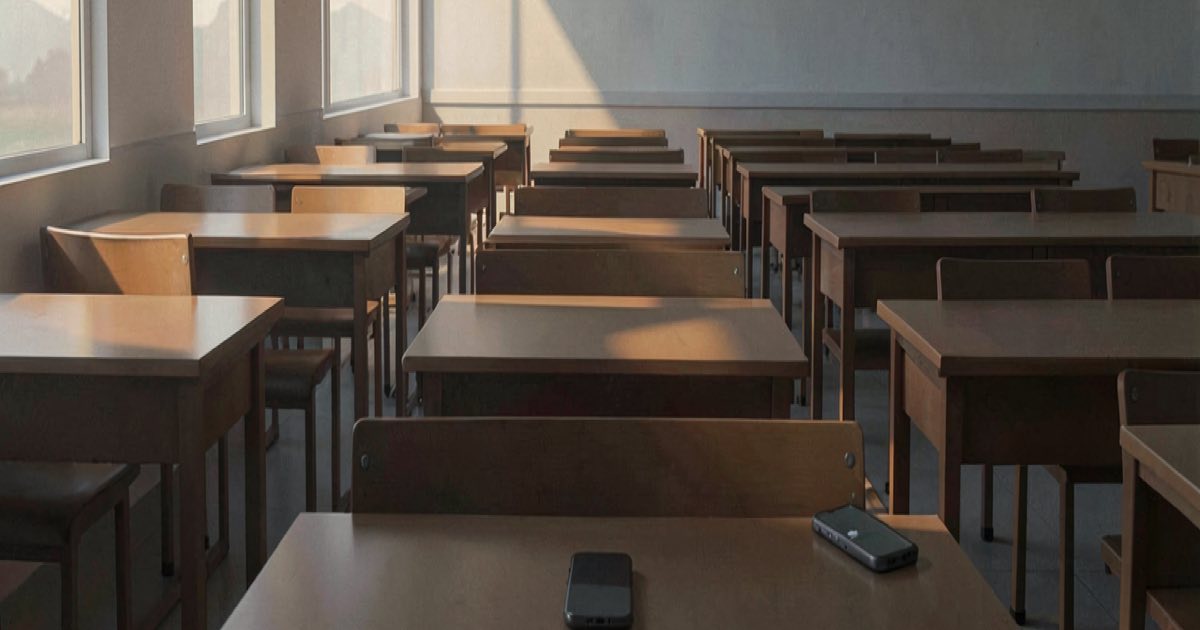
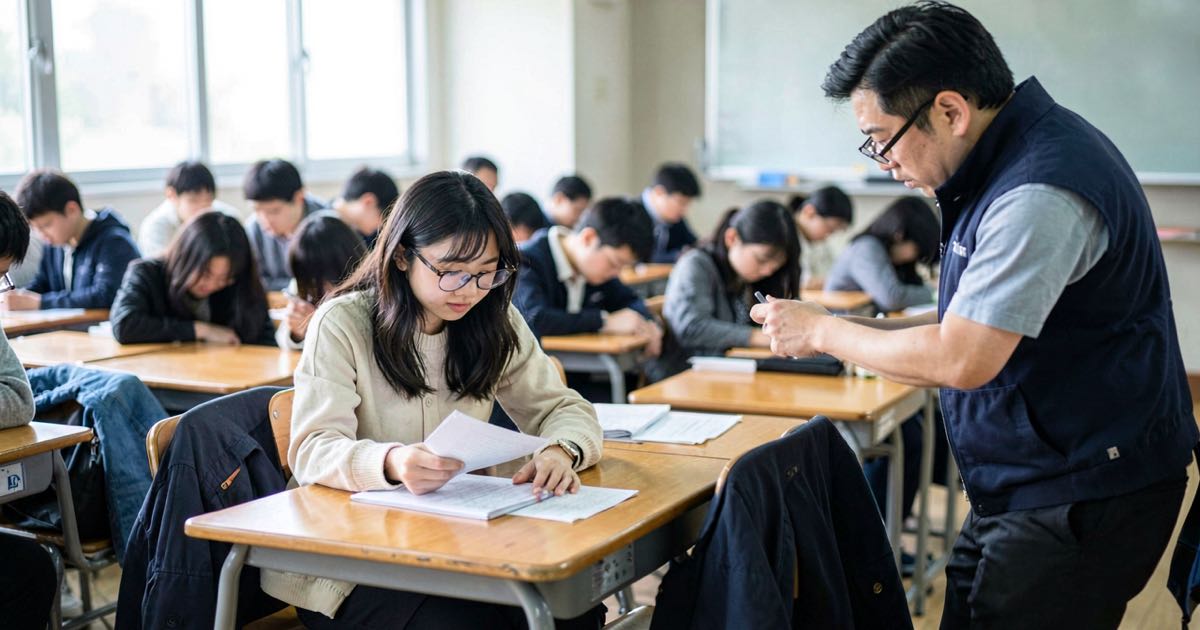
The measures were not routine screening — they were a live national drill. Phones across the country blared in unison even on silent mode, including tourists’ roaming handsets. Candidates wore tape over buttons so hidden cameras could not hide behind them. According to the BBC, invigilators inspected eyewear — and honest students took it personally. One high school senior told the Korea Times he worried his horn-rimmed spectacles would flag him as a suspect, which tells you exactly what kind of exam-week this was for the roughly 499,890 candidates carrying no device at all.
It is the endpoint of a crisis that has been building all month. As we covered last week, Han Won-seok — the top scorer on the Certified Tax Accountant exam, 397.5 out of 400 with a single question wrong out of 160 — confessed on lawyer Lee Don-ho’s YouTube channel to photographing questions with a microcamera, sending them to a generative AI tool and checking answers on a smartphone, in front of a live proctor and past every technical check. The Guardian carried his words: “I cheated using electronic devices and generative AI. My passing the exam with the top score was not the result of fair effort.” The qualification was set to be revoked, and anyone caught using AI faces a five-year retest ban.
Why this is a careers story, not just an education story
South Korea’s high-stakes exams are the load-bearing wall of its career structure. Suneung determines university placement; university placement and professional licensing exams — tax accounting, law, accounting — determine entry into the professions. When the integrity of the gate wobbles, the entire signalling system employers and licensers rely on wobbles with it. The New York Times framed the resignation the same way: the minister had presided over anti-AI cheating confusion at an exam that functions as Korea’s career sorting machine.
The response now spreading through the credentials pipeline is human, not technical. RF detectors had already failed HRD Korea’s mock test — every cheat case it caught, a proctor spotted, per reporting carried by The Peninsula that we cited last week. Professional bodies are retooling toward formats AI cannot sit for: US universities have responded to the same pressure with oral exams, and the demonstrated-skill interviews spreading through hiring are the labour-market version of the same move we covered in the OECD’s new skills-first index this morning. The consistent pattern across all of it: verification is shifting from “what did you score?” to “can you perform in front of a person?”
The New Zealand question this raises
New Zealand is not Korea — Suneung is a one-day national sorting event with a single-file career ladder behind it, and NZ’s pathways run broader. But the structural problem travels: NCEA’s digital assessments, university coursework and professional exams here face the same consumer tools, and NZ institutions have already been pushing toward supervised, invigilated assessment after the AI plagiarism wave that hit Australian universities. Korea’s lesson cuts against a comfortable assumption: a high-surveillance state with a proctor in every room failed to detect the pattern until the cheater confessed on YouTube. The durable answer the adaptation wave points toward is assessment (and hiring) built around demonstrated performance — which happens to be harder to fake with a microcamera, too.
There is also the uncomfortable balance to hold. Korea’s measures worked as deterrence but produced collateral: a minister’s resignation, honest candidates made paranoid, and a national alert system pressed into service for exam security. Anywhere weighing an AI-cheating crackdown — including NZ — inherits both columns of that ledger, and the honest reading is that the cost of restoring trust in the credential may now include some of exactly this.
❓ FAQ
How many candidates were caught cheating in South Korea’s 2026 Suneung? The education ministry said 111 candidates were found with unauthorised smart devices during this year’s exam, which was taken by about 500,000 students, per the BBC.
Why did South Korea’s education minister resign? Choi Kyo-jin resigned on Sunday, taking responsibility for “the confusion caused by last-minute measures aimed at stopping AI-assisted cheating” during Thursday’s exam, telling South Korea’s Yonhap news agency that “as the minister in charge, I believe I cannot escape criticism that we failed to prepare in advance.” President Lee Jae Myung accepted the resignation.
What were the emergency alerts during Suneung? Three nationwide alerts sent between 08:00 and 15:00 local time on exam day, the first time South Korea used its national disaster alert system to catch exam cheaters. Phones blared even on silent mode, including tourists’ roaming devices.
What started the AI-cheating crisis? Han Won-seok, the top scorer on the national Certified Tax Accountant exam, confessed on 15 November to using a microcamera, generative AI and a smartphone to cheat, scoring 397.5 out of 400 with just one of 160 questions wrong — days before Suneung.
📰 Sources
- BBC News — “South Korea education minister resigns over exam cheating scandal” (22 November 2026)
- The Guardian — “South Korea education minister resigns after AI cheating scandal engulfs university exams” (22 November 2026)
- The New York Times — coverage of South Korea’s education minister resigning over the anti-AI-cheating exam confusion (22 November 2026)
- The Guardian — “160 questions, only one wrong: top scorer in South Korea tax exam admits AI cheating” (15 November 2026)
— CJ Murden, editor of Singularity.Kiwi. Former digital technologies teacher, author of AI-focused books. Writing with a New Zealand focus.