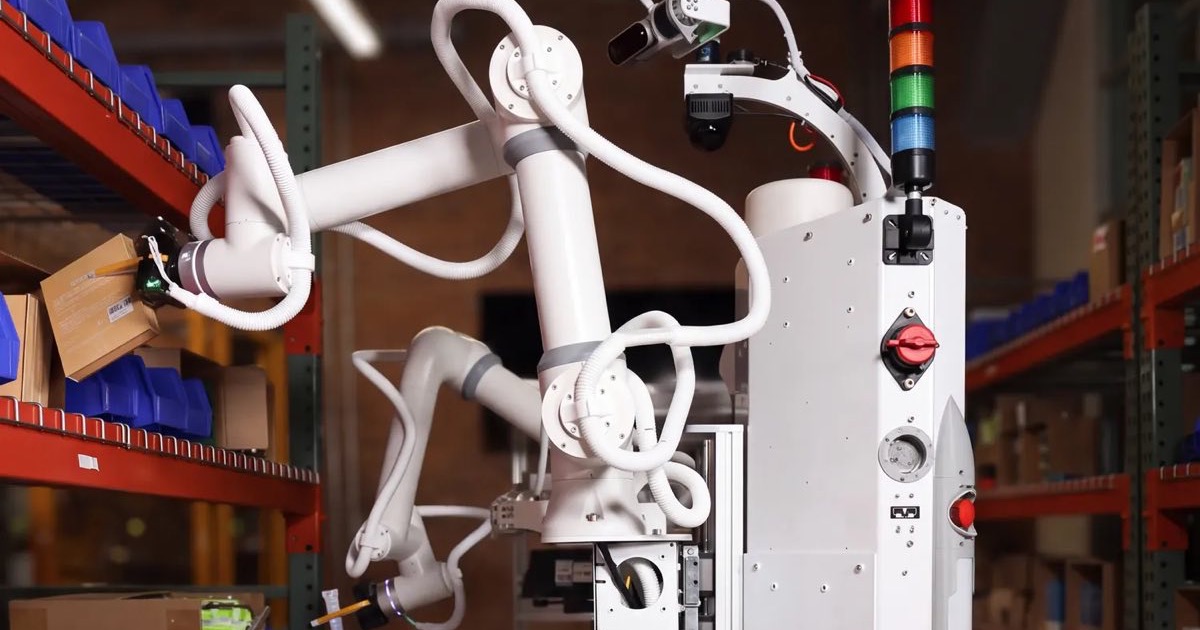
Returns are the job warehouse automation spent two decades designing around. A picked order flows in predictable shapes on predictable packaging; a returned order arrives as a mystery box — crushed, wrapped wrong, sometimes missing its match. The Robot Report writes that Teradyne Robotics, parent of Universal Robots and MiR, has now partnered with the physical AI company Sereact to put exactly that problem onto robot arms at scale, and claims the deployment is already “well beyond the demo or pilot stage.”
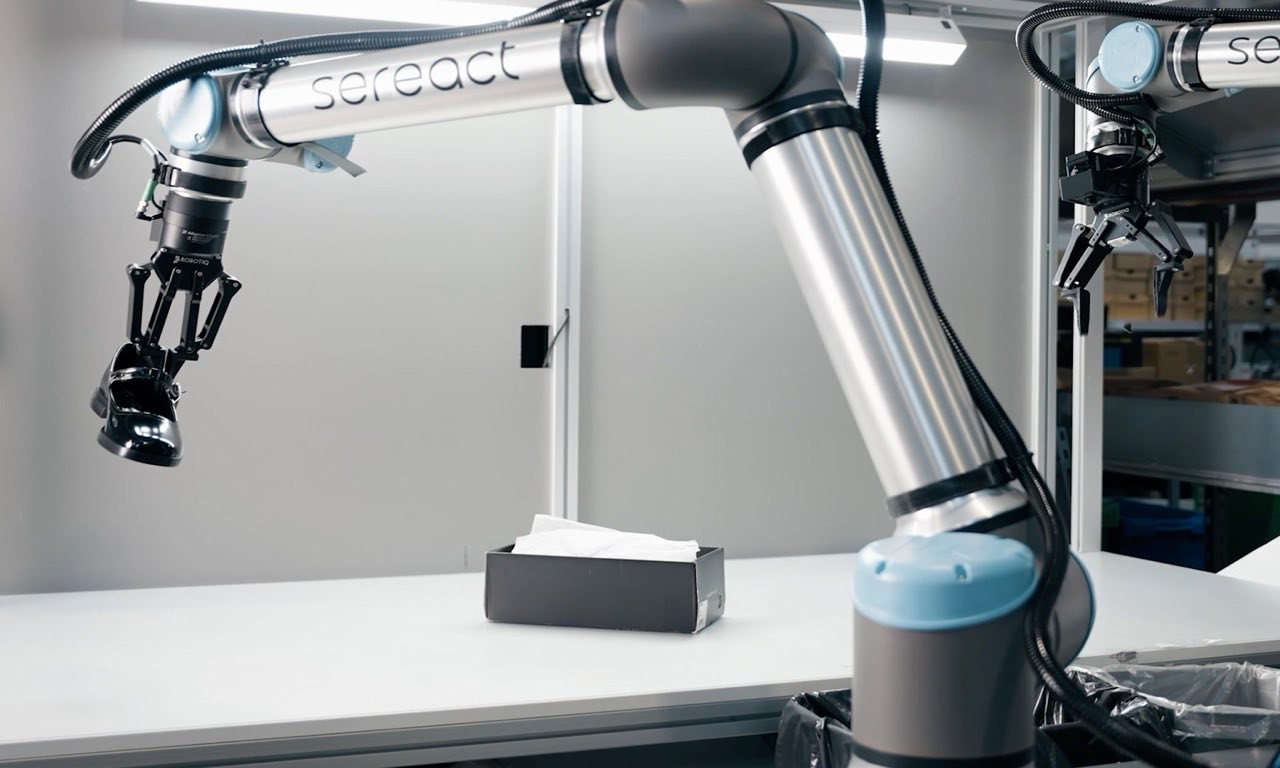
The numbers attached to that claim are the detail worth pausing on. According to The Robot Report, the companies have shipped hundreds of UR robots in dual-arm systems to live customer sites across Europe. At Zalando fulfillment centres in Greven, Germany and Świebodzin, Poland, the robots autonomously process returned fashion items — identifying, assessing, folding and sorting each piece — as the first phase of a scaling plan that spans Europe and extends into North America, where Sereact opened a US headquarters in Charlestown, Massachusetts this summer.
Under the partnership, Sereact’s Cortex platform runs on UR hardware for retailers and logistics providers handling unstructured tasks like returns handling and piece picking. The NVIDIA stack underneath is worth naming because it recurs across this whole industry: Cortex is trained in NVIDIA Isaac Sim using open world models, post-trained with reinforcement learning via Isaac Lab, benchmarked on Teradyne hardware, and deployed with NVIDIA Jetson Thor doing inference at the robot cell while DGX Spark handles site-level development work. Teradyne is also contributing SimReady OpenUSD robot assets — its UR and MiR products — to NVIDIA’s SimReady Central Library on Hugging Face, which means future sim-trained behaviours start life already knowing the shape of a UR arm.
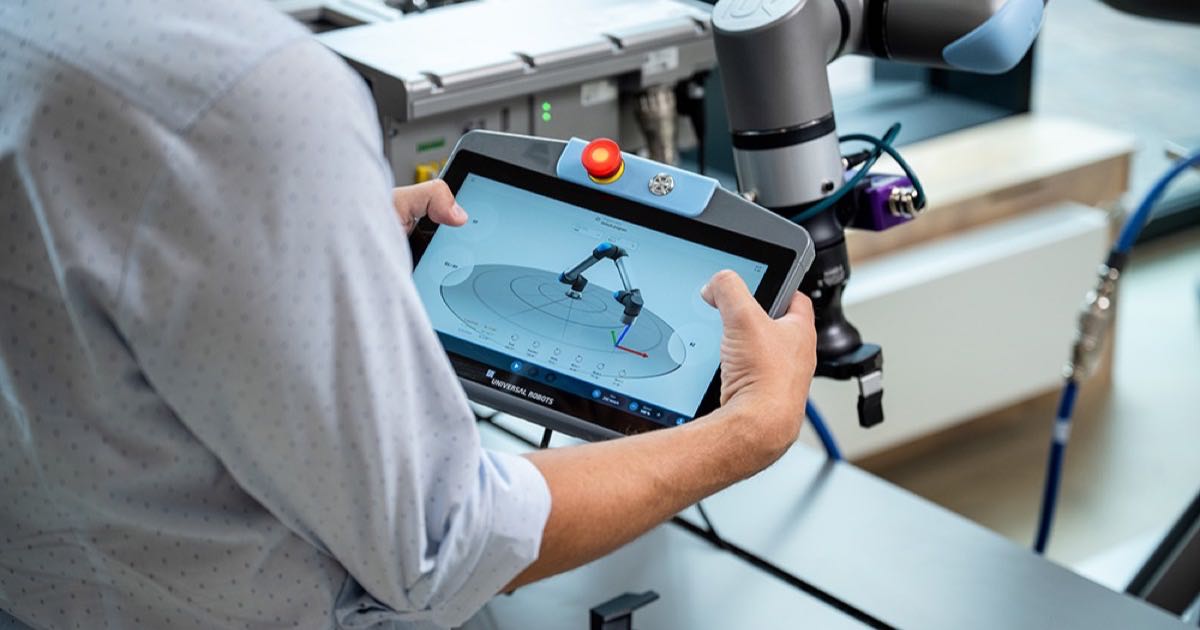
“Physical AI only matters when it performs in real-world operations, and that is where Universal Robots has always been at home. Our robots are built for the AI era: open, connected, and proven through more than 100,000 industrial deployments,” said Jacob Pascual Pape, Chief Commercial Officer at Teradyne Robotics.
Sereact chief executive and co-founder Armen Gulde framed the task itself, and his quote is the honest version of what this deployment actually is: “Returns are one of the hardest jobs in logistics. Returned products almost never arrive in a robot-friendly sequence. Items differ in shape, orientation and packaging, and the mix changes continuously.”
There is history behind the partnership being news at all. In early October, Sereact, Zalando and CEVA Logistics announced the launch of AI-powered automated returns processing at the same German and Polish facilities, and WWD’s Sourcing Journal reported that Zalando went further and invested in Sereact directly — joining a Series B round that brings the total to $116 million — a validation, as that report put it, of Cortex as a universal AI operating system able to run across single-arm picking cells, dual-arm return stations and humanoid robots alike. Today’s Teradyne partnership extends the same platform onto the cobot maker whose arms already sit in more than 100,000 deployments worldwide.
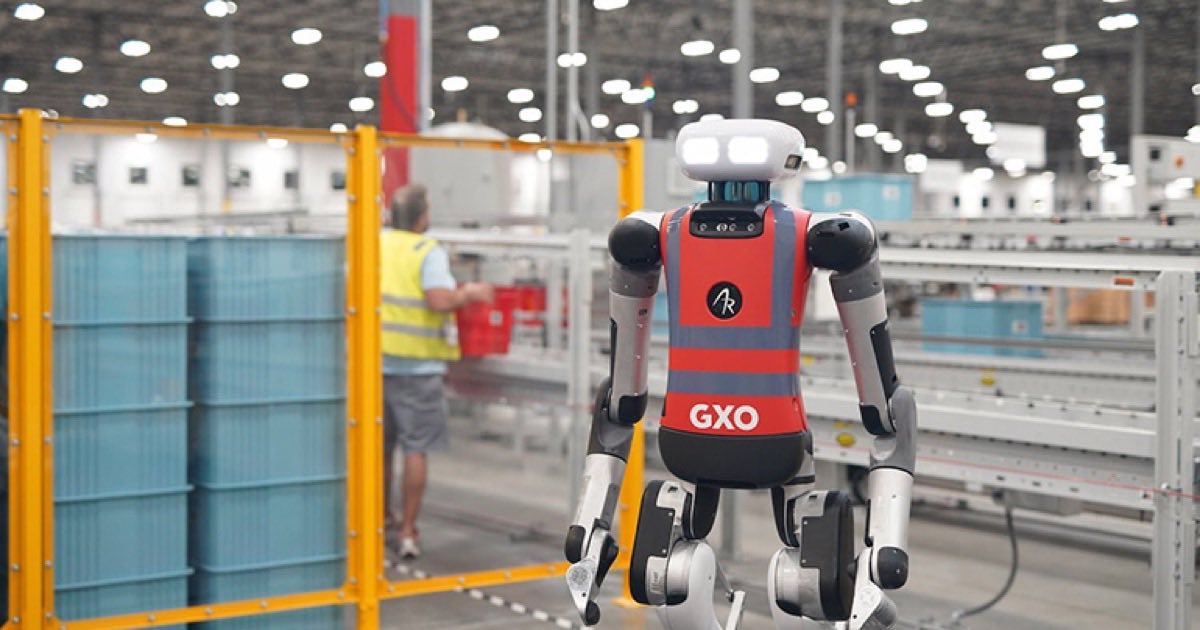
Why returns, specifically, is the tell. Most warehouse robotics wins have come from constraining the world until machines can cope: uniform totes, fixture-fed items, engineered flows. Returns resist all of that by nature, which is why the job stayed human even as picking and packing automated. If a vision-plus-language-model stack can grade a crushed sneaker, fold a crumpled jacket and route a mislabeled parcel without a fixture in sight, that is a stronger signal of physical AI generalising than any choreographed stage demo this month — including the humanoid variety. The work is repetitive enough to justify the capex, and unpleasant enough that labour is hard to hold: warehouse operators consistently rank returns processing among their highest-churn roles.
The quieter point is who wins. This is now the third distinct hardware form factor — dual-arm cells on UR arms, mobile manipulation, and purpose-built returns stations — running the same Cortex brain, all trained on an NVIDIA stack that sits below every one of them. The cobot war is increasingly a reseller war for a platform someone else owns, and Teradyne’s contribution of robot assets to NVIDIA’s library is, read plainly, an admission of where the leverage sits. For the logistics operators actually buying cells, though, that consolidation has an upside: behaviours proven on one site in Germany can retrain onto another in Massachusetts without redesigning the cell. That portability, more than any single deployment, is what “beyond the pilot stage” is supposed to mean — and it will be tested when the North American sites go live.