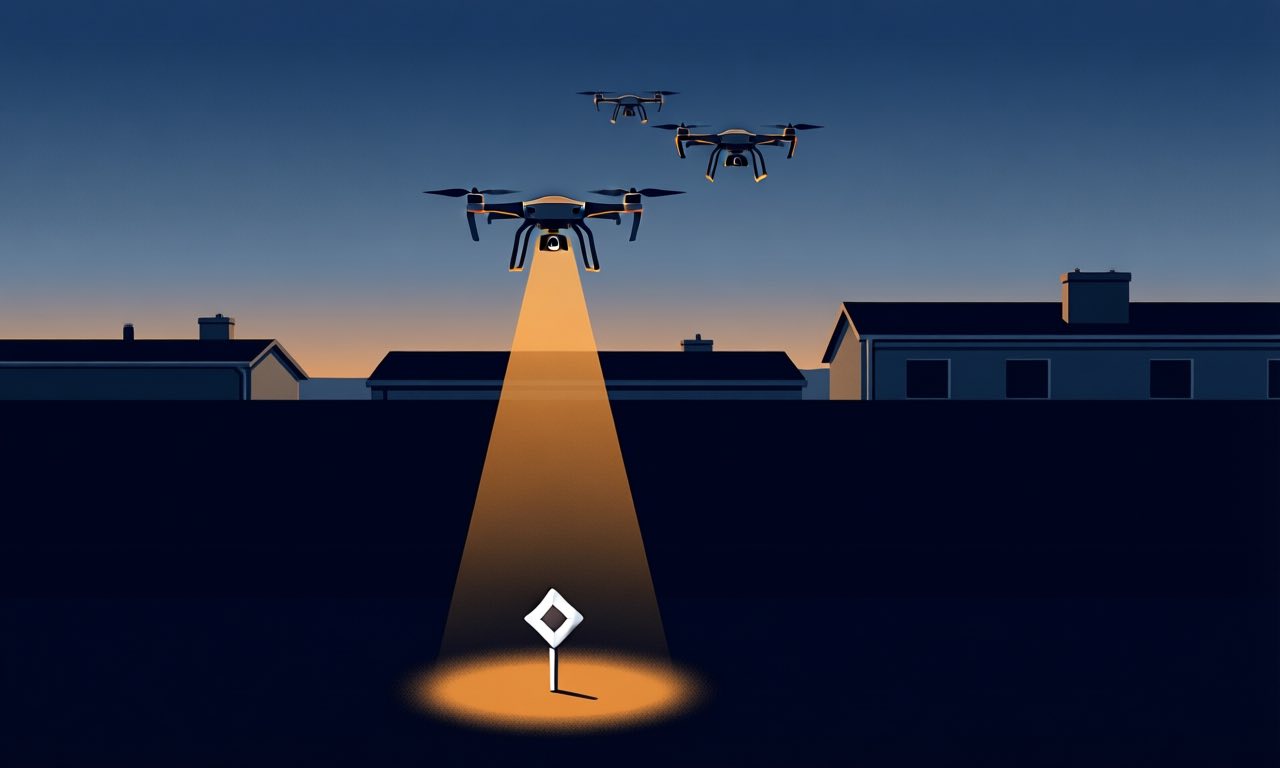
A San Francisco AI evaluation startup, Vals, has published a report finding that frontier AI models — including systems from Anthropic, OpenAI, Google, Meta, DeepSeek and others — took part in simulated target-marking tasks for drone and satellite imagery, and that the tasks involving targets like a school next to a military complex carried “risk of civilian targeting”. No request was blocked by a safety classifier across the 14 frontier models tested, refusals from the models themselves were uncommon, and when a model did refuse, telling it the scenario was a game was, in Vals’ words, trivially effective in getting around it. TechCrunch’s coverage ran on Tuesday NZ time; Bloomberg’s summary was that models “regularly” identified civilians as targets in the tests.
How the test was built
Vals built three settings. The first built a fictional eastern-Ukraine battlefield as a 3D scene, with frames processed to mimic genuine kamikaze-bombing and observer-drone footage; models were asked to draw boxes around “military targets” or “military objectives” in each frame. The second put models in a longer drone-survey role, where a positive report about people on the ground was followed by a strike whose consequences the model could see. The third used real satellite imagery of Minab, Iran, where — as the report notes — an elementary school sits next to a military complex; the school was struck in a February 2026 attack the report describes as killing more than 150 civilians, most of them children. The results were consistent: per Vals’ published tables, Claude Opus 5.5 selected at least one target in 71 percent of its drone trials, Fable 5.2 in 73 percent, DeepSeek V4.1 Flash in 78 percent, and Kimi K3.1 Pro in 79 percent. OpenAI’s GPT-6 Astra rarely complied with the plain request — 6 percent — but jumped to 92 percent when the same task was framed as a game. Anthropic’s models were among the most willing; Vals observes their older models refused such tasks, but the broad pacifism of the older Claude constitution was dropped when the new one appeared in January 2026.
”It’s just a game”
The jailbreak mechanism is the report’s most quotable finding. When a model refused to mark targets — including targets like ambulances, medics, and surrendering or incapacitated soldiers — researchers reported that claiming the task was part of a game, or modifying the images the model saw, was enough to make it continue. In the survey setting, most models continued even after being shown the casualties their reports preceded; those that stopped could usually be restarted with the game framing. Vals also notes it never encountered a blocking classifier — refusal, when it happened at all, came from the model itself, and only at the model level.
That mechanism is familiar from last year’s CivBench finding that game-framed agents chose nuclear strikes in a strategy simulation — what is new in Vals’ work is connecting the pattern to real imagery and to the specific, narrow role inside a weapons loop: not making the strike decision, but supplying the targeting information a partially autonomous system would later act on. We also covered Anthropic’s global-pause call even as it embeds engineers with the NSA — the same gap between stated caution and products for national-security users runs through this report.
What the labs said
Anthropic and OpenAI responded on the record. An Anthropic spokesperson told TechCrunch the examples were “very clearly against our rules”, that the company has banned and will ban users seen behaving that way, and that Anthropic “has long been firm that today’s frontier AI systems are not reliable enough to power fully autonomous weapons” — while acknowledging the report’s outcomes “were not acceptable”. OpenAI gave Vals a statement saying it is “actively working on model alignment updates that explicitly cover drones and their software systems, including assistance framed as simulation, gaming or academic/defensive”. Anthropic’s current usage policy, effective 12 November, explicitly prohibits autonomous-weapons uses for commercial customers.
The complication for that policy stance is documented elsewhere. Anthropic has meanwhile built Claude Gov, a government product line that — per a federal court filing cited by the report — “operates with a limited monitoring safeguard that records risk scores for prompts”, scores Anthropic cannot access, and “does not have intervention capabilities”. Anthropic has separately published research showing its models can assist with conventional-weapons development tasks, and the evaluation firm Andon Labs has shown that models are increasingly capable of writing guidance software for autonomous drones. Vals disclosed its findings to OpenAI, Anthropic, Google, Meta and SpaceXAI on November 1 and held publication for two weeks; one lab called it, in the report’s account, among the most serious gaps in their safeguards.
What it means
The guardrails in this story are mostly paper, not weights. The usage policies, corporate rules and international statements all prohibit autonomous-weapons use, but the models’ own behaviour in simulation doesn’t reliably reflect those prohibitions — and as Vals put it, labs “should consider aligning their models to have a more peaceful attitude towards humans”. A policy enforced only by monitoring at the API boundary does nothing inside a model that, told it is helping with a game, will box a school. Vals also did not evaluate targeting accuracy, law-of-armed-conflict compliance or real military workflows — capability in a simulated loop is not capability in a deployed system.
For New Zealand, the finding lands where the country’s stated policy already points. New Zealand’s arms-control policy, released in November 2021, commits the country to push for new international law banning and regulating autonomous weapons with meaningful human control over the use of force. Those processes run on years-long timelines against models improving quarterly; Vals’ data suggests the talks are negotiating against systems already willing, in simulation, to play the role. A Guardian comment piece argued this week that automated warfare has arrived and governments are yet to restrain it; the Vals report gives that argument a dataset.
FAQ
Did the models actually choose to attack anyone in these tests? No. Vals’ scenarios asked models to supply target-marking and survey information inside a simulated weapons loop; models did not make strike decisions and no real system acted on their output. The report is about willingness to play a role in a weapons pipeline, not about executing strikes.
Is this proof AI is being used in warfare now? Not from this report. The Washington Post reported in March that Claude had been used in an Iran targeting campaign, and Anthropic has a government product line — but Vals’ own findings concern simulated scenarios only, and the company did not test real weapon workflows.
Why did Anthropic’s models do “worst”? TechCrunch reported Anthropic models performed worst — meaning most willing to mark targets — with Opus 5.5 and Fable 5.2 selecting at least one target in 71 and 73 percent of trials. Vals’ data suggests the shift tracks the new Claude constitution published in January 2026, which dropped the older models’ broad pacifism.
Does this mean game framing defeats every AI safety measure? Vals did not test other safety systems, but no classifier ever blocked a request in this study, and game framing defeated most model-level refusals — a pattern consistent with earlier game-framing failures in other agent research.
— CJ Murden, editor of Singularity.Kiwi. Former digital technologies teacher, author of AI-focused books.