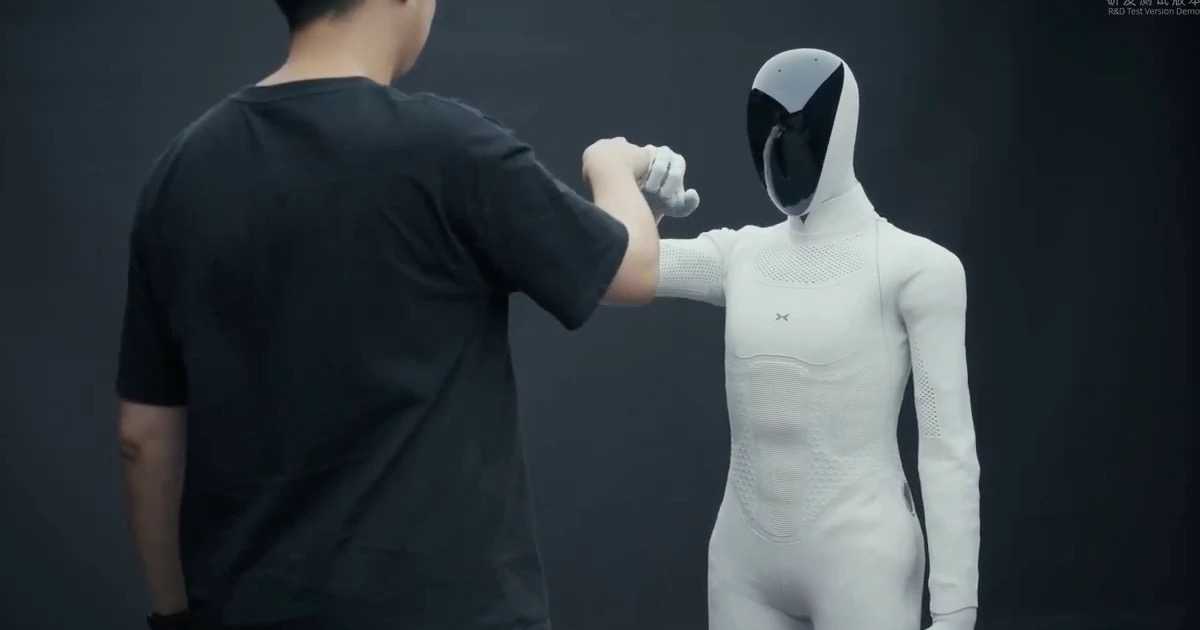
XPENG has posted a new demonstration of its IRON humanoid doing something deceptively simple: keeping a greeting alive while the human changes it. In the video, the robot starts a handshake, switches to a fist bump when the tester does, and leans across with its other arm when a high-five drifts out of reach of the first. No voice commands, no scripted sequence — the robot follows the hand. The footage was posted on XPENG’s Global X account on October 22, and Humanoids Daily’s writeup walks through what the company claims underneath.
The claim is VLA 2.0, XPENG’s vision-language-action stack. According to XPENG, IRON re-evaluates what it sees every 0.2 seconds — five reasoning updates per second — in a continuous loop of observation, motion planning and execution. That loop is why the robot can change plans mid-gesture instead of committing to one movement and hoping the human keeps up.
What the demo actually shows
It is worth being precise about what is and isn’t proven here, because the gap between the caption and the footage is where humanoid demos usually live. XPENG’s post says IRON “predicts your next move.” The behaviour demonstrated is narrower: adapting to changing visual cues as they happen. Humanoids Daily flags this directly, and notes the video discloses no success rate, no attempt count, and no end-to-end latency figure from seeing a gesture to responding.
The 0.2-second number has a similar nuance. It is the re-evaluation interval — a 5 Hz reasoning loop — not a measured reaction time. A robot that re-plans five times a second can still be slow between perception and motion; the interval tells you how fresh the robot’s picture of the world is, not how fast it moves. The footage also carries an R&D test-version label (visible as a Chinese-language watermark in frame), which is XPENG being more honest than most about the maturity of what it’s showing.
CEO He Xiaopeng framed the demo as a step toward everyday use, writing on X that “natural interaction begins with these simple moments,” with continued improvements letting IRON “enter daily life and create value.”
Why handshakes are a harder problem than they look
A greeting gesture is a genuinely brutal test for a robot, and not because the motion is complex. Handshakes are physically improvisational: the human’s hand arrives at a speed and angle no planner fully predicted, contact forces are variable, and the social cost of a fumble is immediate and legible. A robot that can hold its own through a two-second unscripted exchange with a moving human is demonstrating closed-loop control under exactly the conditions factory demos smooth away.
This is also where XPENG’s strategy diverges from the Tesla path we covered in Optimus’s Fremont early-production push. Tesla’s public narrative is manufacturing throughput; XPENG keeps showing social-physical interaction — the skills a home or storefront robot needs before a factory wants it. When we covered XPENG’s US$900 million robotics raise, the company targeted mass production of IRON in late 2026 with commercial deliveries from 2027. Interaction demos like this are the argument that there will be something worth delivering to. And as the IFA 2026 line-up of Chinese humanoids showed, the social-interaction demo has become a genre — every serious Chinese OEM now has one, which makes the differentiators speed, reliability data, and price rather than the trick itself.
The New Zealand read
For a local audience watching the humanoid market take shape, the interesting number in this story isn’t 0.2 seconds — it’s the delivery timeline attached to it. Consumer-adjacent humanoids with competent physical social skills landing commercially from 2027 means the questions NZ businesses and regulators will face about robots in public-facing service roles are nearer than they feel. A robot that reads gestures is a robot designed for untrained users — the very users whose safety standards, ACC liability questions and retail deployment rules are, as of publication, largely unwritten here.
XPENG, for its part, has disclosed no independent benchmarks for this demo. As of publication, the footage stands as company-reported capability: impressive in frame, unverified in number.
Sources: Humanoids Daily, XPENG Global on X, He Xiaopeng on X.