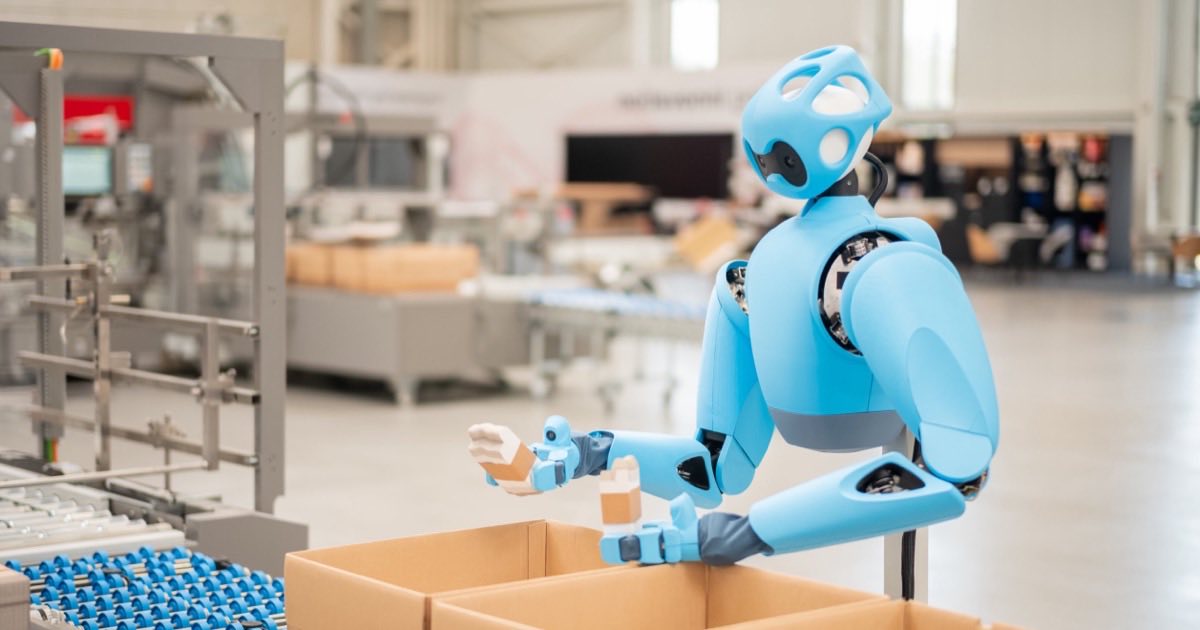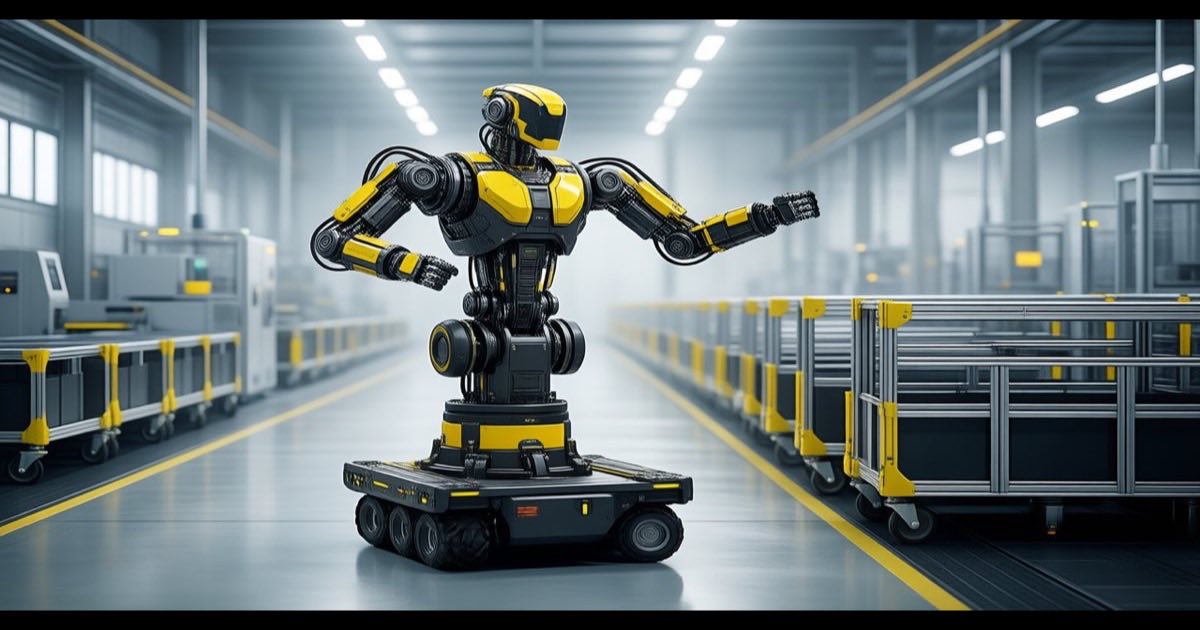
For US factories buying robots made abroad, the paperwork changed this summer — and now the first company has made it through the new filter. Ati Robotics, an India-founded maker of factory automation robots now headquartered in Michigan, announced that five of its platforms, including the Sherpa Mecha industrial humanoid, received conditional US Department of War approval exempting them from the FCC’s Covered List. The FCC published the approval on October 30 (notice DA 26-1181) under the company’s US legal name, ATI Motors, Inc.; as of that date, per the company, Sherpa Mecha is one of only two humanoid robots cleared and the only one built for factory work.
The clearance covers the whole Ati line-up at once: Sherpa Mecha, the Sherpa 10K and 3K autonomous tuggers, and the Sherpa FlexFork 1500 and 3000 forklifts. All five remain eligible for the FCC equipment authorisation required to sell communications-equipped hardware in the United States.
What the Covered List means for robots
Since July 28, 2026, foreign-produced “advanced robotic devices” have been placed on the FCC’s Covered List unless cleared through a national security review — the same list that made Huawei and ZTE the shorthand for telecommunications equipment deemed a security risk. The definitional trigger is deliberately broad, as John Koetsier’s analysis lays out: any foreign-made robot over 4.4 pounds, carrying sensors and 200+ kbps of connectivity, that isn’t a vehicle, aircraft, underwater device, medical device or stationary industrial arm, is in scope. That describes essentially every modern mobile robot an American plant might want to buy.
The underlying logic is the factory floor itself. A connected robot navigating a plant builds a detailed map of the facility — line layouts, throughput patterns, inventory movements — data with obvious intelligence value if a foreign government can reach it. The same reasoning that kept Huawei out of telecom infrastructure now applies to a sensor-laden robot roaming a defence contractor’s plant.
“Foreign-produced” follows Buy American domestic-content rules — 65% component content in 2026, rising to 75% by 2029 — so the review is also quietly forcing decisions about where robots get built.
Conditional, and deliberately opaque
Conditional approval is doing real work in that sentence. The clearance is tied to Ati’s onshoring plan and ongoing product vetting, and neither Ati nor the FCC has published the full terms. Koetsier reads the opacity as intentional: publishing the conditions would hand rivals a checklist. What is public is the direction — Ati had already taken a larger Michigan site this year, and CEO Saurabh Chandra tied the approval directly to that: “the FCC action simply reinforces our belief that autonomous robots are strategic technology and must be treated as such by enterprises.”
The company is a useful first case study because it sits neatly inside the rules rather than around them. Founded in 2017 in Bengaluru, it is an Indian-founded company with a US headquarters, claims more than 2 million autonomous missions across 70-plus factories, customers including Hyundai and TVS Motor, about $37 million in total funding — and its own software stack, which matters when the review asks who controls the robot’s brain. It is small next to the giants of the industry, which is precisely why its clearance is instructive: the process is navigable for a company that can show domestic manufacturing plans, controlled software and US-based support.
Sales VP Siddharth Bhagra’s account of the year makes the market effect explicit: US customers kept asking, before payload or price, whether the robots “will be cleared to ship and be serviced long term.” Security review has moved from procurement fine print to the first question on the call.
The wall now works in both directions
Three days ago China blocked SoftBank’s purchase of ABB Robotics over data-transfer concerns; we covered the rescue plan taking shape today. Put the two stories side by side and you have the same wall viewed from opposite ends: Beijing screening who may own robots that work in China, Washington screening whose robots may be sold into America. Ati’s passage through the US filter and ABB’s block in China are the same process running in mirror image, with the data the machines generate as the common concern — a framing we explored when Unitree’s IPO forced Chinese humanoid makers to open their books, and again at IFA where Chinese humanoids faced European buyers.
For buyers, the practical consequence is a new pre-purchase step that didn’t exist 18 months ago: check whether the robot you’re specifying is, or can become, Covered-List-cleared. Ati’s sales VP has just told you what the first question on every call is now. And it cuts both ways — as with Autel’s listed drones still receiving FCC-waived security patches, the rules are catching an installed base as well as new sales, which is where the operational headaches will gather.
There’s an irony worth savouring too: per an FCC notice published November 6 (DA 26-1203), ABB Robotics’ own AMR platforms cleared the same review process the same week its robotics deal died in Beijing. The Swiss company was threading the American filter while losing the Chinese approval — the two halves of its robotics business split by two governments’ definitions of security.
For New Zealand plants, the relevance is indirect but real: the major export markets are installing security screens around robot supply, and machines cleared for one jurisdiction are increasingly designed, built and serviced inside it. Global robot sourcing is splitting into zones, and procurement teams here will feel it in lead times and support arrangements long before any New Zealand equivalent of the Covered List appears.
Sources: Ati Robotics via PR Newswire, FCC Public Notice DA 26-1203, HumanoidMegaHub, The AI Insider, Yahoo Finance. Clearance terms are not fully public; details about conditions reflect company statements and FCC notices.