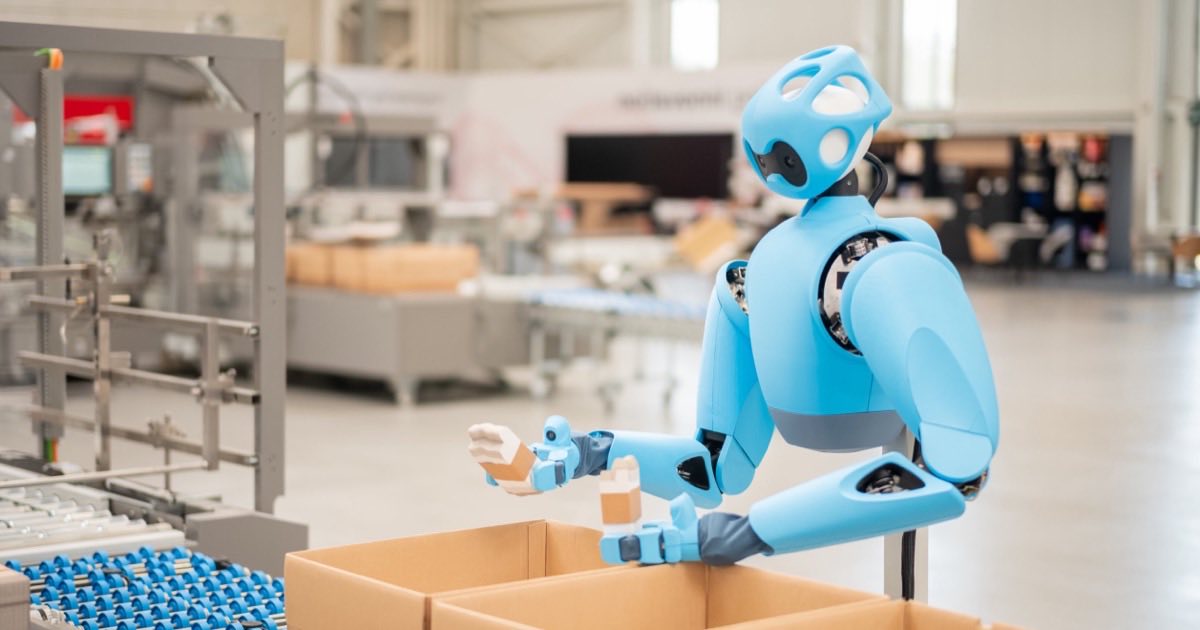
A 25-person robotics startup spun out of Switzerland’s EPFL has unveiled a humanoid robot with no legs at all. Embodied AI showed off AIR at the Humanoid Europe 2026 conference in Munich on 6 November, and the design brief is blunt: a torso, two light arms and a head on a wheeled base, built to work beside factory staff without a safety cage. Humanoids Daily, which covered the launch on site, reports orders open after the unveiling but no pricing or delivery schedule yet.
🔍 THE BOTTOM LINE
While the big-money humanoid race chases legged robots that can go anywhere, a Lausanne startup is betting factories will buy something deliberately less ambitious: a robot whose safety comes from physics rather than software speed limits. The bet only pays if “safe near people” matters more to factory buyers than “walks like a human” — and the first test is whether AIR’s promised 2027 CE marking actually lands.
Why build a humanoid that can’t walk
The company’s answer is mass. A conventional industrial arm is heavy and stiff, so hitting someone causes real harm, which is why most industrial robots sit behind fences or light curtains. Embodied AI keeps the motors, gearboxes and electronics in AIR’s torso and drives the arms through cables — a tendon-driven layout that keeps the moving arms themselves almost massless. The arms are built to yield on contact, and the company’s press release states the design targets ISO/TS 15066:2016, the collaborative-robot safety spec, with CE marking planned for 2027.
The wheels-versus-legs call follows the same logic. Factory floors are flat, and wheels are more stable and far cheaper than a bipedal gait. It is a genuinely contrarian position in a year when roughly every major humanoid unveiling has featured knees.
CEO Francesco Stella, 28, put the philosophy plainly in the launch announcement: “If an AI system recommends the wrong product to you, nobody gets hurt. But if a robot makes a mistake and hits someone, obviously you don’t want that.” The release also argues that safety should come from how the robot is built, “not from software holding it back.”
Teleoperate first, automate within a month
AIR’s deployment model starts with a human in the loop. A remote operator runs the robot through its first shifts — so the customer gets productive work before any AI policy has been trained on their task — while every run is recorded as training data. According to the company, the robot takes over autonomously within about a month, though Humanoids Daily notes the 95% average task-success figure comes from paid pilots of the company’s earlier two-armed robot cell, and Embodied AI has not said how many tasks it covers or how success is defined. Investors from Look AI Ventures describe a 2 kg tendon-driven arm that lifts 5 kg; height, weight, reach and battery life are all unpublished.
That caveat matters, but the underlying claim is more concrete than most humanoid marketing: the same AI stack already runs on a customer production line in that earlier two-armed robot cell, and the company says a consumer-electronics manufacturer’s cable-handling trial saw it hit 98% reliability against a 90% target where five other funded startups had missed the bar. Company-supplied numbers, unverified — but a customer production line is further than most legged-humanoid programmes have got.
The cageless race has a European lane now
Embodied AI is not alone in thinking factories want robots beside people rather than fenced away. Agility Robotics partners with FORT to connect its Digit 5 humanoids to a factory’s external safety systems, and fellow Swiss startup mimic robotics raised $16 million to put dexterous hands on standard industrial arms. AIR’s differentiation is that the physical design itself limits the force it can apply — no bridge box, no retrofit. The cageless approach also has recent company on this site: Agility’s Digit 5 shipped with exactly this pitch, and wheeled workhorses are already holding eight-hour shifts in Xiaomi’s EV factory.
The regulatory clock gives the timing its edge. The EU’s Machinery Regulation (EU) 2023/1230 replaces the Machinery Directive from 20 January 2027 and adds requirements for machines with self-evolving behaviour and for collaborative operation near people. A robot designed under ISO/TS 15066 with CE marking planned for exactly that year is timed to walk — roll — through the new door. Until the mark exists, though, AIR cannot be sold as a finished machine in the EU, which makes 2027 the year this startup either proves its thesis or stalls.
❓ FAQ
Is AIR a humanoid if it has no legs? By the industry’s functional definition — two arms, a sensor head, human-scale manipulation — yes, and Embodied AI markets it as one. Purists will call it a mobile manipulator. The distinction that matters commercially is that it works where humans work without cages, which is what buyers are actually paying for.
How does a robot learn a factory task in a month? Embodied AI starts every deployment with a remote operator piloting AIR while every run is recorded. Those demonstrations train the company’s task-specific models until the robot takes over by itself, per the launch coverage, typically within a month. The operator then stays available for situations the robot hasn’t seen.
Are the 95% and 98% success figures verified? No. Both come from the company: the 95% is an average across paid pilots whose task count and success definition were not disclosed, and the 98% cable-handling figure was supplied by Embodied AI. Treat them as claims pending independent review, not measurements.
Why does the CE timing matter? The EU Machinery Regulation takes effect 20 January 2027 and tightens rules for AI-driven machines operating near people. Embodied AI plans CE marking for 2027, aligning certification with the new regime — the gate between “impressive demo” and “sellable product” in Europe.
What does this mean for New Zealand manufacturers? The relevant signal is the deployment model, not this particular robot. Teleoperation-first means a NZ factory could trial robotic assistance without a robotics team on staff — the operator can be anywhere — and the wheeled, cageless shape suits the mixed, human-dense floors typical of local light manufacturing far better than a caged six-axis cell.
🔍 THE BOTTOM LINE
Embodying the opposite of the legged-humanoid orthodoxy is a real strategy: cheaper, safer by construction, and timed to a regulatory regime that rewards exactly this design. The risks are equally concrete — every performance number so far is company-supplied, and nothing ships in Europe until a 2027 CE mark that doesn’t exist yet. The next milestone to watch is the first independent confirmation of a paid AIR deployment with an operator in another country.
📰 Sources
- Humanoids Daily — full launch coverage from Humanoid Europe 2026
- Business Wire / Robotics Tomorrow — Embodied AI press release
- EME Outlook Magazine
- Embodied AI (embodiedai.ch)