Estonia’s government says it can now state “with full confidence” that the fire which burned through the Tallinn offices of defence robotics maker Milrem Robotics on the night of August 15 was an act of sabotage commissioned by Russian special services — per the government’s announcement Wednesday, built on an assessment by the Estonian Internal Security Service (ISS). “We can conclude with certainty that the arson attack… was an act of sabotage ordered by the special services of the Russian Federation,” Foreign Minister Margus Tsahkna said, as the BBC reports. The Kremlin rejects the accusation as unfounded; Russia denies operating a sabotage campaign in Europe. The allegation has not been tested in any court, and the accused government disputes it — that framing is the story: an accusation of state sabotage, on an EU and NATO member’s word, denied by the accused.
Who Milrem is, and why it matters to Ukraine
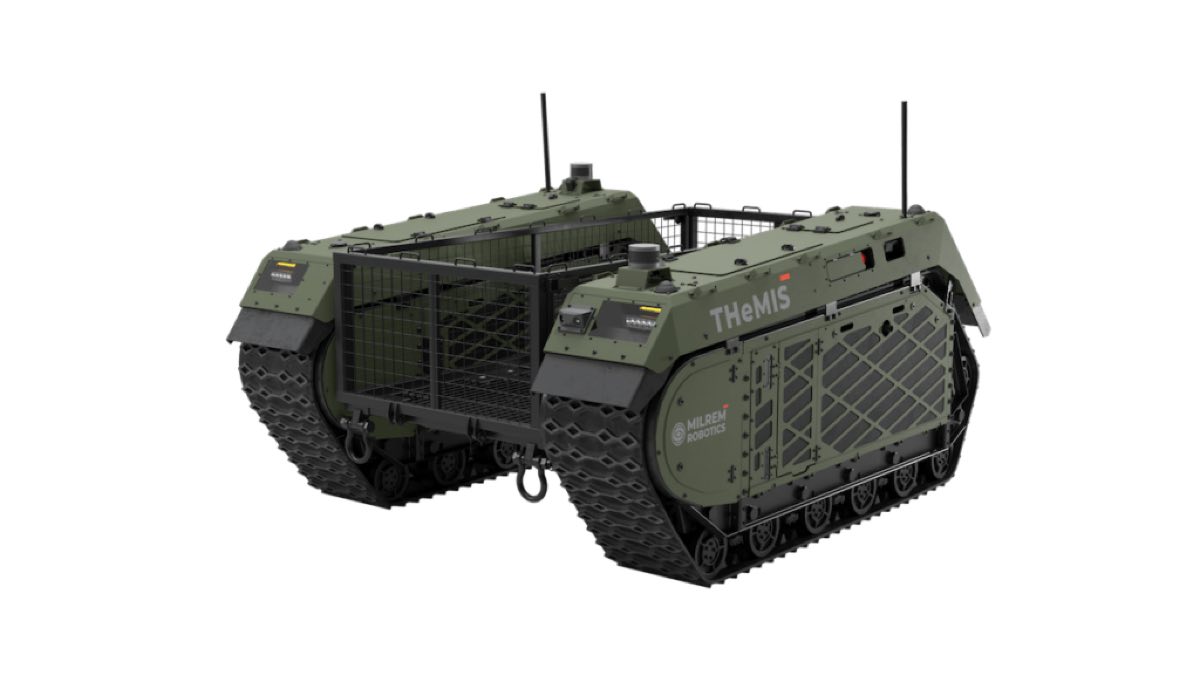
Milrem Robotics is Estonia’s flagship defence robotics manufacturer. Its THeMIS unmanned ground vehicles — the tracked, flat-bed platforms the company markets in cargo, reconnaissance and remote-weapon configurations — are used by Ukraine’s armed forces, and the company describes its technology as combat-proven in Ukraine (Milrem’s own materials list customers across NATO states). The company is also, per BBC reporting, part of a defence supply chain Moscow has openly designated hostile: Russia claims military factories across Europe are legitimate targets, and EU states disagree.
The fire itself caused no reported injuries and was quickly extinguished, Novaya Gazeta Europe reports. The path to Wednesday’s announcement ran through three Latvian citizens, who were detained in Latvia last month and extradited to Estonia earlier in September; per the BBC, citing the ISS director, the perpetrators were Latvians who had been living in Russia and had taken part in previous attacks.
The accusation and what it fits into
Prime Minister Kristen Michal framed the fire as part of something wider: “an act of sabotage… part of Russia’s broader campaign in Europe, aimed at intimidating Europe and forcing it to reduce its support for Ukraine” (per ERR). ISS director general Margo Palloson told the broadcaster that Russian services were “constantly planning, looking for opportunities, trying to find people who would carry out attacks” — and that the Milrem fire was Russia’s first successful attack this year, per the BBC. Estonia’s Foreign Ministry summoned Russia’s chargé d’affaires in Tallinn on Wednesday, and the response from allies was immediate: French President Emmanuel Macron called the acts “a dangerous escalation,” NATO Secretary-General Mark Rutte said Russia was “failing” to undermine European unity, and an EU spokesman said support for Ukraine would not cease (per the BBC and DW).
The pattern behind the accusation is a summer of them: as the BBC lists, August alone brought the Leipzig airport drone incident in Germany, a major fire at a defence warehouse in Bulgaria, an explosion at a munitions factory near Rome, an attempted arson at a Ukrainian-owned drone maker in Slovakia, and two suspicious fires in Poland. Defence-robotics manufacturers sit on that target list precisely because their products are already in the field.
Why a robotics-adjacent story matters for AI and robotics readers
Three threads here matter to anyone tracking where robotics goes. First, the attack is on a robotics manufacturer — Milrem’s “combat-proven” autonomy stack is now formally, in one EU government’s assessment, the target of state-directed sabotage. If the accusation stands, the physical supply chain of military robotics joins software supply chains as contested territory. Second, the incident lands three months after Estonia became the first country to require ID codes for AI agents — the same small state is now dealing with attacks on physical robot factories, a reminder that the country doing the most AI-governance pioneering is also on the frontline of what hybrid pressure actually looks like. Third, the sabotage campaign targets the industrial base that humanoid and UGV sceptics and boosters alike depend on: the European robot deployments may be consumer theatre for now, but defence robotics is where revenue, urgency and state interest intersect first.
What we still don’t know
The Estonian government has not named evidence beyond “the information ISS has gathered,” and no independent forensic account of the fire exists in public reporting. The Latvian suspects’ own accounts and their trial outcomes will matter; ERR reported this month they were remanded after extradition, and proceedings continue. And the Kremlin’s denial is, at time of writing, the only comment from the accused. Between Estonia’s classified intelligence, a court process still under way and a flat denial, the reader is left with a government’s assurance and an enemy’s denial — which is, truthfully, where most sabotage reporting ends.
📰 Sources
- BBC — “Estonia blames Russia for arson at defence company supplying Ukraine” (September 29, 2026)
- ERR News — “Estonia: Russia responsible for arson attack on defense contractor Milrem” (September 29, 2026)
- DW — “Estonia blames Russia for arson attack on defense company” (September 29, 2026)
- Novaya Gazeta Europe — “Estonia alleges fire at Tallinn robotics plant was Russian arson attack” (September 29, 2026)