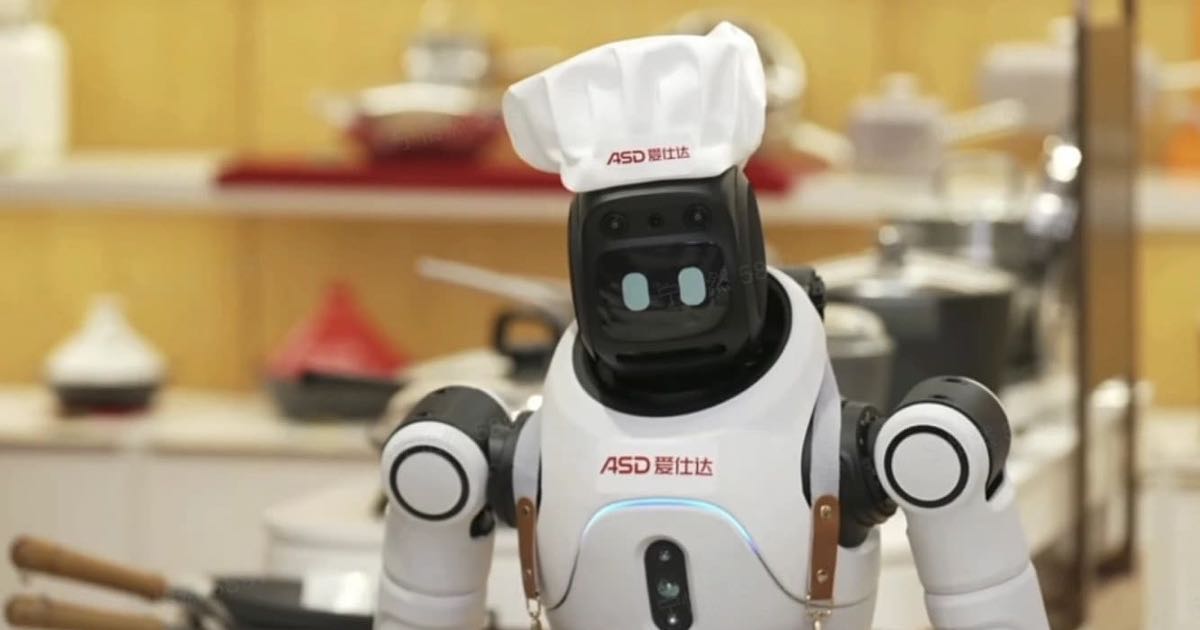
AGIBOT is trying very hard to make humanoid robots a thing you meet while shopping for a wok. On 28 September the Shanghai robotics company announced a partnership with ASD (SZSE: 002403), a leading Chinese cookware and kitchenware maker, to deploy 100 AGIBOT X2 humanoid robots across 100 retail stores in China — with the robots working as in-store sales assistants. Trade outlet Humanoids Daily covered the announcement on 29 September. As of publication, the deployment has not been independently reported beyond the company’s announcement and that trade coverage.
The announced role is deliberately modest. According to the company, X2 greets customers, asks about their needs — the release describes it consulting household size, cooking habits and budget — then recommends cookware, explains features and guides shoppers around the store. Anything touching money or stock is human territory: promotions, inventory and final purchases are handled alongside, or by, human staff.
AGIBOT’s illustrative anecdote: a family of three walks in wanting a wok for Chinese stir-fried dishes, budget under RMB 1,000. The robot asks its questions, recommends an option, explains the material, the non-stick coating and high-heat suitability. Then the customers ask about in-store promotions, and X2 hands the conversation to a human associate, who closes the sale.
That handoff is the most honest part of the announcement. “Retail environments present a very different challenge from controlled demonstrations. Humanoid robots need to interact with different customers, respond to a wide range of needs and work alongside store employees throughout the day,” said Zhihui Peng, AGIBOT’s co-founder, president and CTO, in the release. A product conversation draws on stable information — specs, prices, cooking technique. A transaction requires current store-specific detail and responsibility for payment. AGIBOT has drawn the line exactly where the legal and practical risk starts, and said so in the press release rather than pretending otherwise.
The publicity wrapper is a three-day livestream, running 28–30 September from stores in Wenling, Shanghai and Wuxi, ten hours a day, from 10 a.m. to 8 p.m. China time. It ends today. Humanoids Daily’s analysis makes the right caveat: a broadcast schedule does not establish a ten-hour battery runtime, and footage from three selected stores does not verify operation at all 100 locations. The release offers no sales impact figures, no intervention or autonomy rates, and no commercial terms — the numbers that would tell you whether this is a deployment or a demo tour at scale.
What AGIBOT is announcing fits a pattern the site has tracked since mid-year: a fast-moving commercialisation push that has taken AGIBOT past Unitree in China’s humanoid shipment race and turned out 9,700 humanoid robots in six months, ahead of the company’s 20,000th-robot milestone this month. It also follows AGIBOT’s Chimelong theme-park deployment of more than 300 robots. The retail placement is a visible, public-facing step — robots where ordinary shoppers encounter them, not robotics expos.
There is a structural reason for the timing. AGIBOT began a Hong Kong IPO process in July 2026, and China’s securities regulator has since set out three tests for humanoid robot IPOs — real deployments among them. A listed-bound humanoid company needs commercial deployment stories, and “100 humanoids working in 100 stores of a listed kitchenware firm” is a story. The disclosure gap is the tell: nothing in the release measures whether the robots improve sales or service. As Humanoids Daily puts it, the announcement establishes the claimed deployment scale and the division of work; the business results remain to be shown.
Our take: watch the intervention rate, not the livestream. If AGIBOT publishes the share of customer conversations the robots complete unassisted, and staff hours per shift spent supporting the machines, this is a real service-robotics programme. If the livestream ends and the numbers never come, you saw a marketing exercise with good optics. A wok is a wok from Wenzhou to Tauranga — service-assistant humanoids are heading for consumer retail in more places than China, and the honest deployments will be the ones that report what happened when the customers got difficult.