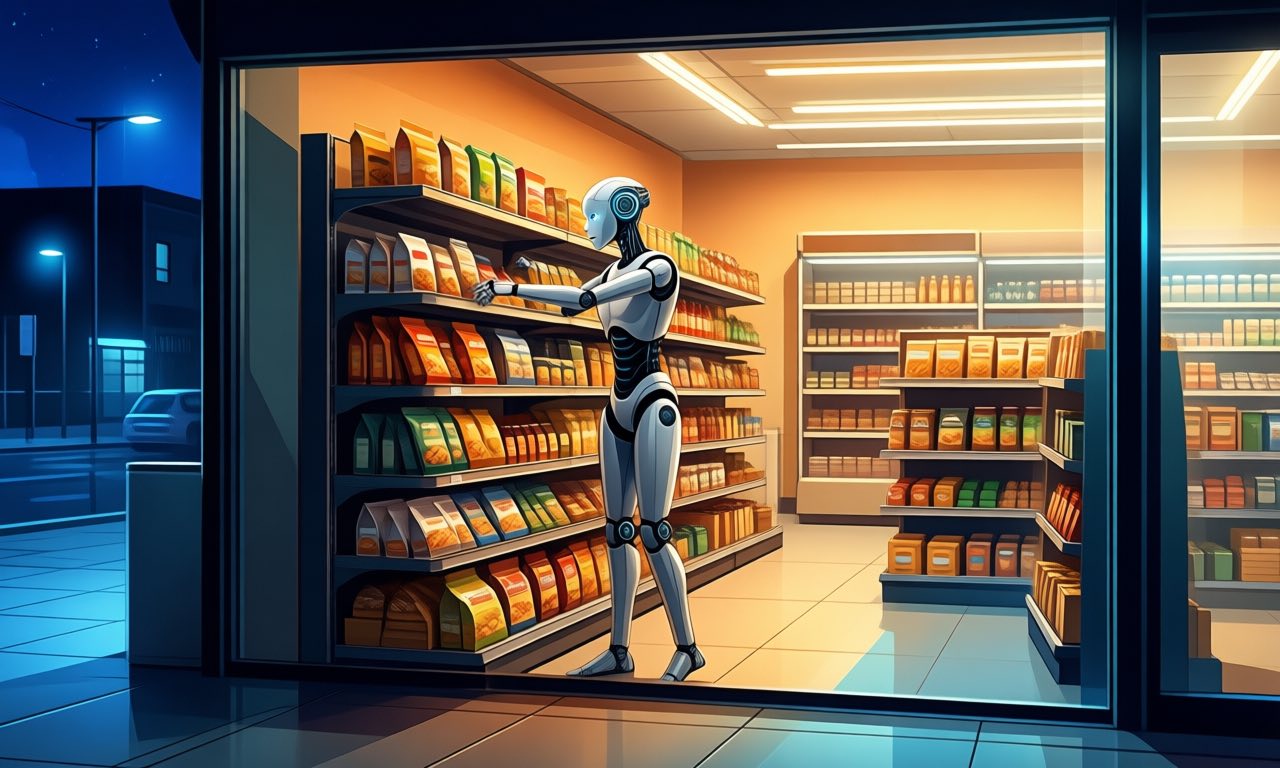
Six AGIBOT G2 humanoid robots spent 24 hours running a real convenience store in Shanghai’s Xuhui district this week — greeting customers, restocking shelves, making coffee, running the checkout and cleaning tables — in a livestreamed trial the company says drew more than 2 million viewers. The final tally: 1,730 completed tasks out of six robots on one shift, four of the six passing the event’s own probation review. As Pandaily’s report on the run details, the trial ran from 10:00 on November 2 to 10:00 on November 3, and closed out AGIBOT’s “AI WAVE” release series that began on October 22.
The task breakdown is where it gets interesting: 683 customer receptions, 369 item fetches and deliveries, 147 coffees, 126 breakfast orders, 277 restocking and shelf checks, and 128 table cleanings. Each robot held a fixed role — door greeter, two pick-and-restock units, barista, checkout, cleaner. That division of labour is itself a design statement: AGIBOT isn’t claiming a universal store worker, it’s arguing for narrow roles stitched together by software.
Genie Master is the actual product
All six robots were coordinated by Genie Master, AGIBOT’s embodied-agent framework, which links task decisions, motion execution and feedback through what the company calls its Embodied Execution Protocol. The system reviews successful and failed runs each day, stores useful experience in long-term memory, filters corrected attempts into training data, and the robots practiced during quiet hours. AGIBOT says the test ran with no human in the loop — no demonstrations, no on-site tuning.
That’s the claim to scrutinise, because it’s the part that generalises. A robot that can pull a coffee shot after a week of tuning is a demo. A fleet whose failure logs become next week’s training data is an industrial method — the same collect-retry-improve loop that turned ChatGPT from a parlor trick into a product. AGIBOT isn’t just selling robots here; it’s selling the pipeline that makes them better, and the store is the data-collection rig.
What the trial proves — and what it conspicuously doesn’t
The caveats are real. Invited testers actively tried to break the system — mixing regular and sugar-free cola and asking for the sugar-free one, scrambling a shelf of chewing gum, dropping boxes in the aisle — and per the reports, the robots handled it by cross-checking voice requests against shelf visuals, counting items rather than trusting price tags, and rerouting around obstacles. Fine manipulation stayed hard: hanging bags of candy on hooks and picking up soft cake without crushing it tripped the robots repeatedly.
And the elephant in the accounting: AGIBOT published task counts, not success rates. Company VP Ren Guanghui told media the company would track task success rate, first-attempt success, response time, takeover frequency and system availability — then released none of those numbers. Two robots failed the probation review outright. As Interesting Engineering’s analysis notes, a 24-hour livestream shows longer performance than a stage demo but “does not prove uninterrupted autonomous operation,” and the promotional material doesn’t specify an intervention policy or scoring system. TechSpot framed it more bluntly: two of six failed the assessment.
Why this matters more than the stage demos
Everyone in humanoid robotics can fill a hotel ballroom with applause-earning sequences. What almost nobody has is a machine earning money in a real customer-facing business across a full operating day — rush hour, the dead hours, the breakfast scramble. That’s the niche this trial stakes out, and it’s why the convenience-store setting matters more than the 2 million viewers: retail is a brutal, low-margin, high-variability testbed where customers don’t perform for the robot.
AGIBOT has form here. We’ve covered its 100-X2 deployment across 100 ASD cookware stores — a much bigger deployment with no published metrics at all — and Worken, the robot-productivity metric AGIBOT proposed at Innovation Day, which prices robots in useful work rather than units shipped. The pattern across both is consistent: AGIBOT keeps manufacturing the instruments by which it would be judged, then declining to publish the readings. A company that wants the industry measured in useful work delivered has an obligation to lead on disclosure — success rates, takeover frequency, the numbers Ren Guanghui himself listed. Until then, treat 1,730 tasks as marketing and the four-of-six pass rate as the honest headline.
For the market that matters — Chinese factory and service robotics racing toward profitability — the trial is a genuine data point: six humanoid workers, one unremarkable store, no humans in the loop, and a failure rate the company won’t name. The honest read is in the middle: further along than the demos suggest, less proven than the livestream implies.