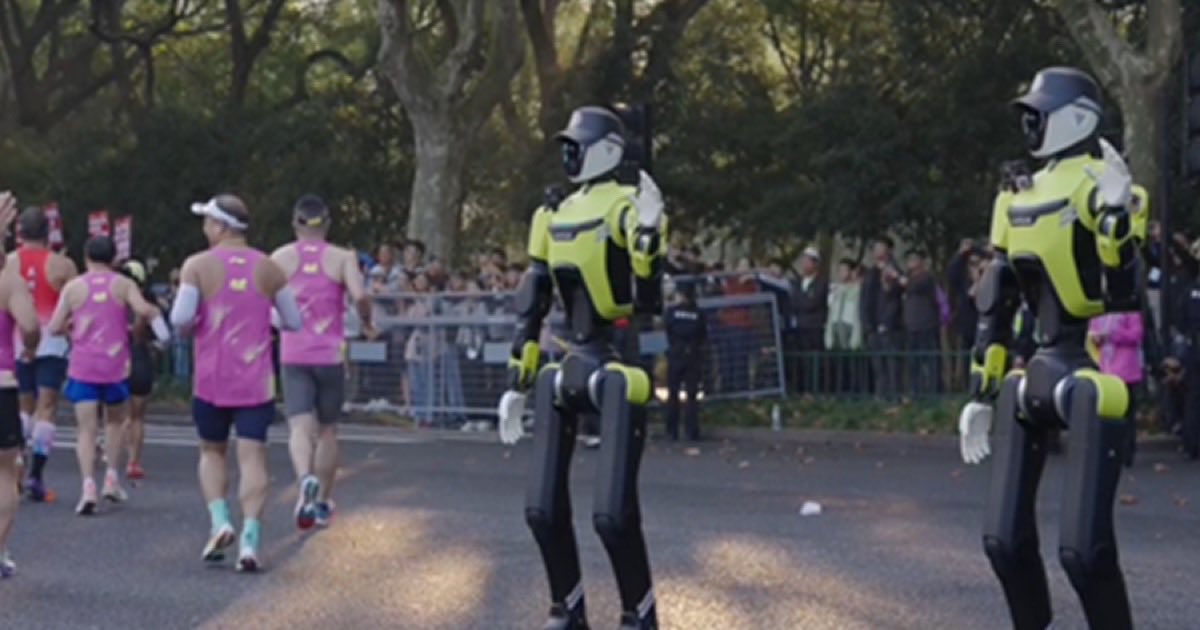
A humanoid robot worked traffic at China’s biggest city marathon on Sunday, and almost nobody outside the local press noticed. On 1 November, a DEEP Robotics humanoid called Hangxing No.2 joined a four-point patrol team around a 36,000-runner event in Hangzhou, handling intersection monitoring, patrol routes, violation warnings and public directions while volunteers in hi-viz normally do it. Global Times reported the machine is built on the DR02 platform and carries an IP66 rating — fully dust-tight and rated for heavy rain and high-pressure water jets.
🔍 THE BOTTOM LINE
The remarkable part of this story is not that humanoid robots can walk and wave. It is that a municipal authority quietly treated a 36,000-person event as routine work: DEEP Robotics says the marathon was chosen precisely because “security is concentrated in time, with dense crowds and highly repetitive tasks” — the clearest municipal endorsement yet that mass-event duty is now standard humanoid territory, not a demo. The IP66 rain rating matters as much as the legs: it is hardware that expects to be rained on while working.
The machine that stood in the drizzle
Hangxing No.2 is 178 centimetres tall, runs on a 275 TOPS compute unit, and fuses LiDAR, a depth camera and a wide-angle camera into one perception stack. The operating envelope reads like something designed for a New Zealand winter rather than a showroom: -20°C to 55°C, with no caveats about dry conditions. DEEP Robotics’ representative Meng Yuan told Global Times the deployment is “an exploration of a standardized application model for humanoid robots in traffic management at large marathon events.”
What it actually did sounds mundane, which is the point: patrolling preset routes, moving between guard posts, spotting jaywalking runners and delivery vans cutting into closed lanes in real time, performing standard traffic-control gestures while broadcasting safety advisories. The organising committee’s framing was equally blunt — traditional security “were not always able to cover every blind spot,” so the robot’s job was to turn fixed cameras into a mobile pair of eyes. WION’s video report from the start line shows two of the units working the barriers in yellow-black livery.
This is the second time round, and the scale is different
Hangzhou has been rehearsing this for months. In early May, the city rolled out China’s first coordinated robot traffic-police squad — 15 machines around West Lake during the May Day holiday, with 15 machines from maker SUPCON covering key routes and testing during the West Lake and Women’s Half Marathons in March and April. By August, Reuters’ numbers via The Independent had the fleet issuing more than 170,000 warnings and cutting helmetless riding and stop-line violations by over 40 per cent monthly — figures the outlet noted were not independently verified, and Hangzhou police did not respond to comment requests. Beijing’s Yizhuang Half Marathon used similar robots as far back as April 2025 and 2026.
What changed on Sunday is the hardware class and who signed off. The May fleet used SUPCON’s wheeled T2 units built for fixed intersections; Sunday’s machine is a legged DR02 from a commercial humanoid maker, working a moving 36,000-person event across multiple points, deployed jointly with the city’s traffic authorities. It is the difference between a robot installed at a location and a robot deployed with a task pack.
The gap between demo and duty, measured in one number
The telling number in Global Times’ report is not the 275 TOPS or the 3,000-applicant-to-one bib ratio. It is that DEEP Robotics is now talking about a “standardized application model” — the language of a company productising a service, not running a one-off stunt. Figure’s humanoid climbs a ladder autonomously in a warehouse; a Xiaomi humanoid trains in a factory; and meanwhile a Chinese provincial capital has already decided what its first paid municipal job is: standing in the rain, telling people where to go. The jobs arriving first for humanoids are not the glamorous ones. They are tedious, safety-adjacent, shift-defined, and nobody’s career ambition.
There is an uncomfortable question for traffic authorities everywhere in this, including New Zealand’s. If a machine can fill road-cone-and-hi-viz duty at scale for the cost of a lease, the lowest-skilled traffic-control roles — often staffed by students and casual workers — are the first in line. New Zealand’s road-cone economy has been an international punchline for years; it is also, on Sunday’s evidence, exactly the job class humanoids are being productised for first.
As of publication, the deployment has been reported by Global Times as the primary event-day source and picked up in WION’s video coverage; no Western tech outlet had covered the marathon deployment. The violation-detection figures above come from company and police statements, not independent audit.
❓ FAQ
What is the Hangzhou Marathon robot police machine? Hangxing No.2 is a humanoid traffic robot based on DEEP Robotics’ DR02 platform, deployed with Hangzhou traffic authorities at the 2026 Hangzhou Marathon on 1 November. It handled intersection monitoring, patrols, violation warnings and public directions.
Who makes the Hangzhou Marathon humanoid robot? Hangzhou-based DEEP Robotics, better known for its legged research robots, built the DR02 platform. The company worked with Hangzhou’s traffic authorities on the deployment model.
Is this China’s first humanoid traffic robot? No. Hangzhou deployed China’s first robot traffic-police squad — 15 SUPCON wheeled units — around West Lake in May, with tests dating to March. Sunday’s deployment is the first marathon outing for a commercial legged humanoid in the DR02 class.
Could robots police traffic in New Zealand? The tasks involved — static point duty, violation spotting, crowd direction — map directly onto New Zealand’s road-cone traffic-management economy, though NZ Police would face procurement, accreditation and public-acceptance questions China’s deployments skip. For context on where these machines are built and exported, see our IFA 2026 coverage.
🔍 THE BOTTOM LINE
A robotics company found its first municipal repeat business not in warehouses or homes but in the most repetitive, weather-exposed, low-prestige job on the street: traffic duty at a big public event. Hangzhou signed off, 36,000 runners streamed past two machines doing slow mechanical waves, and the milestone passed with barely a headline. The humanoid era is not arriving as a dramatic unveiling. It is arriving as a rota entry.
📰 Sources
- Global Times (event-day primary, 1 Nov 2026)
- WION video report (Marathon debut)
- The Independent / Reuters (SUPCON fleet, August 2026)
- Yangtzeer (May 2026 Hangzhou fleet launch)