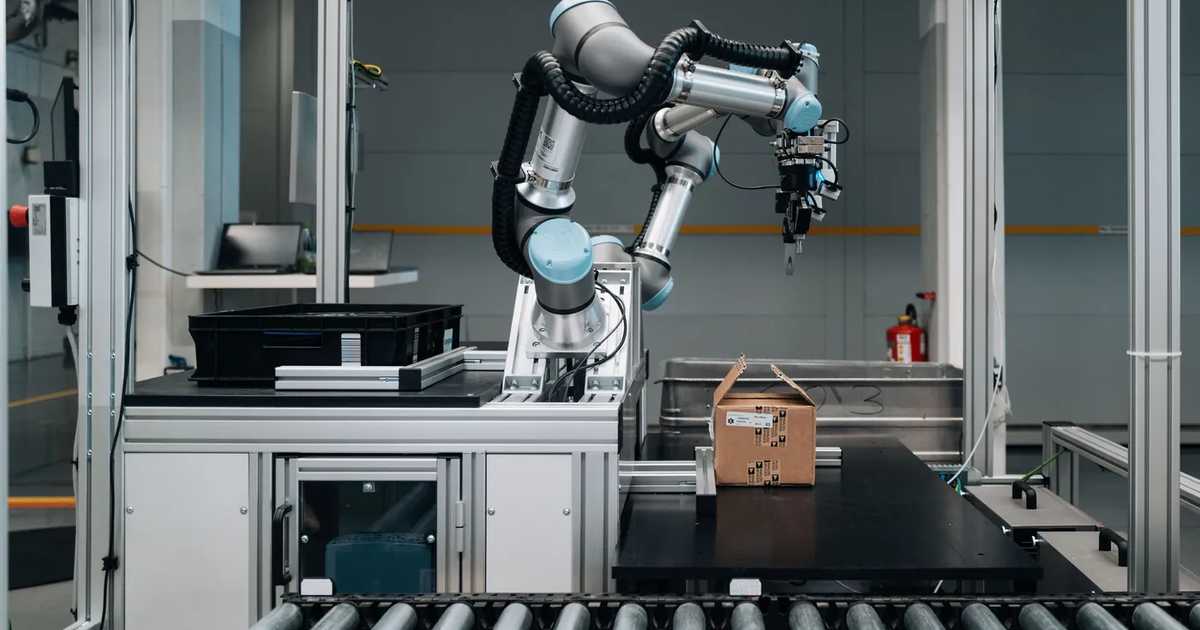
Genesis AI, the two-year-old robotics startup founded by Carnegie Mellon graduates Zhou Xian and Théophile Gervet, has raised a $500 million Series A led by Khosla Ventures, Premji Invest and Eclipse — a round that reportedly values the company at $3.5 billion and makes it one of the most heavily funded physical-AI teams outside the giants. TechCrunch got a hands-on look at the company’s Silicon Valley lab, where its model drove a pair of off-the-shelf arms through a full packing workflow: pick up two boxes, scan them, nest them, fold, tape, then peel a label off a printer strip and apply it. The second run fumbled a box and struggled with the tiny adhesive label — exactly the kind of “hiccup data” the company says makes its training loop work.
The round, announced by the company on November 17, 2026, funds deployment of Eno, its wheeled general-purpose robot, starting in manufacturing and logistics. Genesis has built 30 to 40 Eno units, picked a US mass-manufacturing contractor, and is piloting with a handful of undisclosed customers, with an LG CNS partnership providing a possible deployment route inside LG’s industrial client base.
Why the data plan is the story
What separates Genesis from the Figure-and-Agility cohort is where its training data comes from. Rather than teleoperating its own robots at scale, the company distributes sensor-equipped gloves and headset cameras to more than 100 real workers worldwide, harvesting force data alongside human video. The gloves cost, by the company’s claim, 100 times less than typical alternatives and collect data five times more efficiently. The robots wear the same gloves; their hands are modelled on human proportions. The idea is a 1:1:1 mapping — human hand, glove, robot hand — so a warehouse veteran’s muscle memory becomes model input without a robot ever needing to be taught from scratch.
The second pillar is simulation. Genesis builds on an influential contact-modelling physics algorithm (co-authored by adviser Minchen Li) to run millions of high-fidelity training scenarios, exposing failures cheaply before they reach hardware. Reliability arithmetic is the company’s favourite talking point: a robot that succeeds at each of 20 steps 99% of the time still finishes a full workflow error-free only 82% of the time. That gap — between demo and dependable shift work — is the same reliability gap behind Generative Bionics’ dedicated physical-AI data factory, and Genesis is explicit that closing it, not another benchmark win, is what keeps the industry out of a second robot winter.
The read for the rest of the market
The full-stack bet — model, robot and deployment operation owned end to end — is a wager that vertically integrated control beats the platform plays. Compare Agility’s open Digit v5 pitch, which sells the body and lets buyers supply intelligence, or Booster Robotics’ Android-of-robots platform, which ships APIs instead of opinions. Genesis sits at the opposite pole: own every layer so that a failure on a customer’s floor rewrites the model, the hand, or the next hardware revision. Both strategies now have serious capital behind them, which means by late 2027 the market will have real evidence on which integration bet pays.
It also matters where the money came from. Khosla Ventures and Eclipse backed the $105 million seed in July 2025 and both doubled down; Premji Invest arriving suggests mainstream capital is now comfortable underwriting robot hardware at software-style valuations — $3.5B for a startup pre-revenue-scale is a number that only exists because humanoid deployment pipelines at Hyundai, LG and others have made factory floors feel like a bankable market. As of publication, independent verification of the $3.5B valuation figure comes via secondary reporting rather than the company’s own release.