XPeng hosts its 2026 AI Day tomorrow — November 25 — in Guangzhou, according to a preview reported by Robotics & Automation News. The event, themed “Origin”, is the eighth edition of the company’s annual technology showcase since 2019, and XPeng says it will demonstrate its latest work in physical AI, humanoid robotics and next-generation mobility.
The event date and programme details have not been independently reported; Robotics & Automation News is currently the only outlet covering the preview. The series’ lineage, though, checks out against XPeng’s own materials: the 2025 edition, themed “Emergence” and held on November 5 last year, was where the company unveiled VLA 2.0, its Robotaxi plans, the next-generation Iron humanoid and ARIDGE flying systems. Electrek’s live coverage of that show matches the company’s account, and the announcement of the 2026 edition is also carried on Yahoo Finance’s wire in the same release stream.
The Iron on the bill
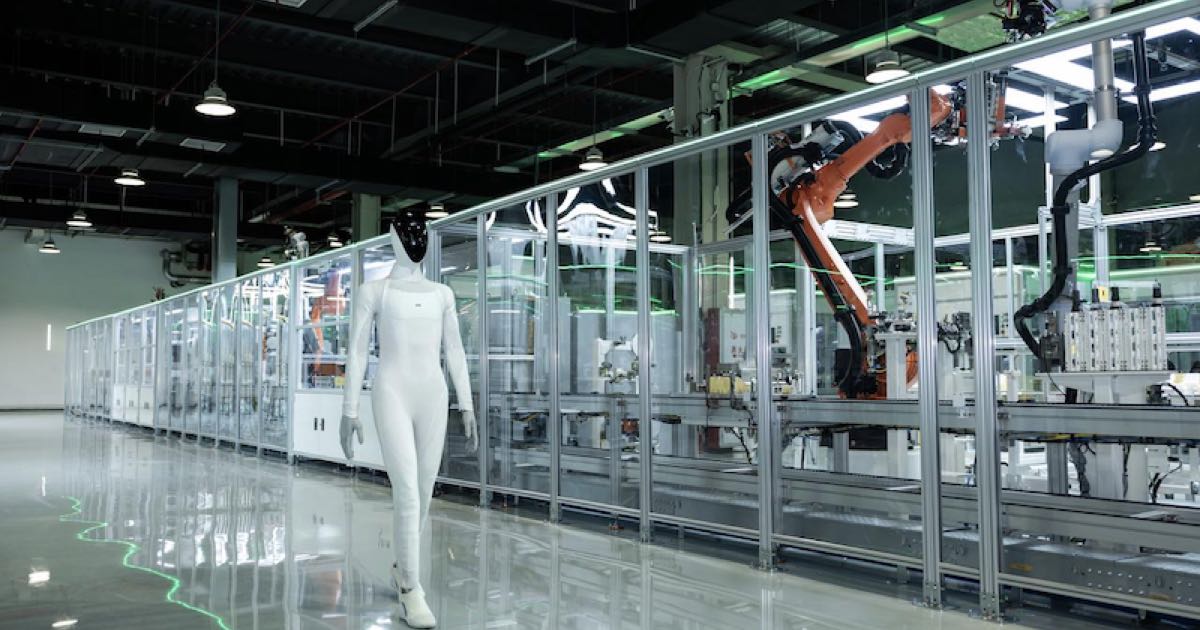
The headline act is Iron, XPeng’s general-purpose humanoid — and this year it walks in with a paper trail. Per the preview, the robot stands about 170 cm, has 76 degrees of freedom across its body and another 21 in each hand, and carries three in-house Turing AI chips rated at up to 2,250 TOPS running the company’s physical AI foundation model on-device. XPeng’s claim is autonomy: task execution without teleoperation.
Two milestones from this year feed the credibility of that claim. The robot rolled off XPeng’s newly commissioned production line on September 8, and in August the robotics business secured over $900 million in equity financing at a post-money valuation exceeding $6.3 billion — which the company called the largest single-round private financing in China’s embodied AI industry. We covered both steps as they happened: the battery component ramp that preceded the robot, the VLA 2.0 gesture-interaction work at last year’s show, and the record raise itself. What Iron still hasn’t received is a public answer on the all-solid-state battery chemistry question, and tomorrow’s programme is the first natural slot for an update.
Beyond the humanoid, the event promises Level 2-to-4 autonomous driving demonstrations — NGP up to an L4 Robotaxi — alongside flying-car updates. XPeng is presenting the full stack as one ecosystem: the same company that sells passenger EVs also wants its robot, its robotaxi and its aircraft to read as a single physical-AI platform.
The argument XPeng is making
The rhetorical core of the preview is a claim about where AI goes next. Powerful AI large models alone, XPeng says, will not be enough for real-world use, because “the complexity and unpredictability of real-world environments require AI to work in close coordination with proprietary hardware and physical systems.” The next stage, in the company’s framing, “will depend on the co-evolution of intelligence and embodiment, enabling AI to perceive, understand, act and continuously learn through real-world interactions.”
That is a pointed thesis aimed at the rest of the humanoid field. XPeng is arguing that the moat isn’t the model — every serious player claims a foundation model — but the closed loop between model and hardware that only a manufacturer with its own fabs, factories and fleet can build. It is the Tesla vertical-integration argument, made by an EV maker with a functioning humanoid production line, and it is also an admission of sorts: if intelligence and embodiment have to co-evolve, then the pure-plays who bought their actuators from a catalogue are always going to carry an integration tax.
The competition will judge the claim with shipments, not slides. Agibot has been pushing hard on volume, with its shipments overtaking Unitree in recent market counts, and Unitree remains the volume price-leader. XPeng’s answer, at Origin, has to be more than Iron — which is exactly where the robot’s actual production numbers, retail deployment plans for 2027 and any VLA successor will matter.
One caution cuts the other way too. Every XPeng AI Day announcement since 2019 has eventually shipped in some form, but “eventually” is the operative word — the flying car alone has been two editions away from mass production for two editions running. Tomorrow is a preview, not a launch, and “further details will be announced at the event,” as the company puts it. Expect the hardware that matters most tomorrow to be whatever carries a date and a factory behind it.