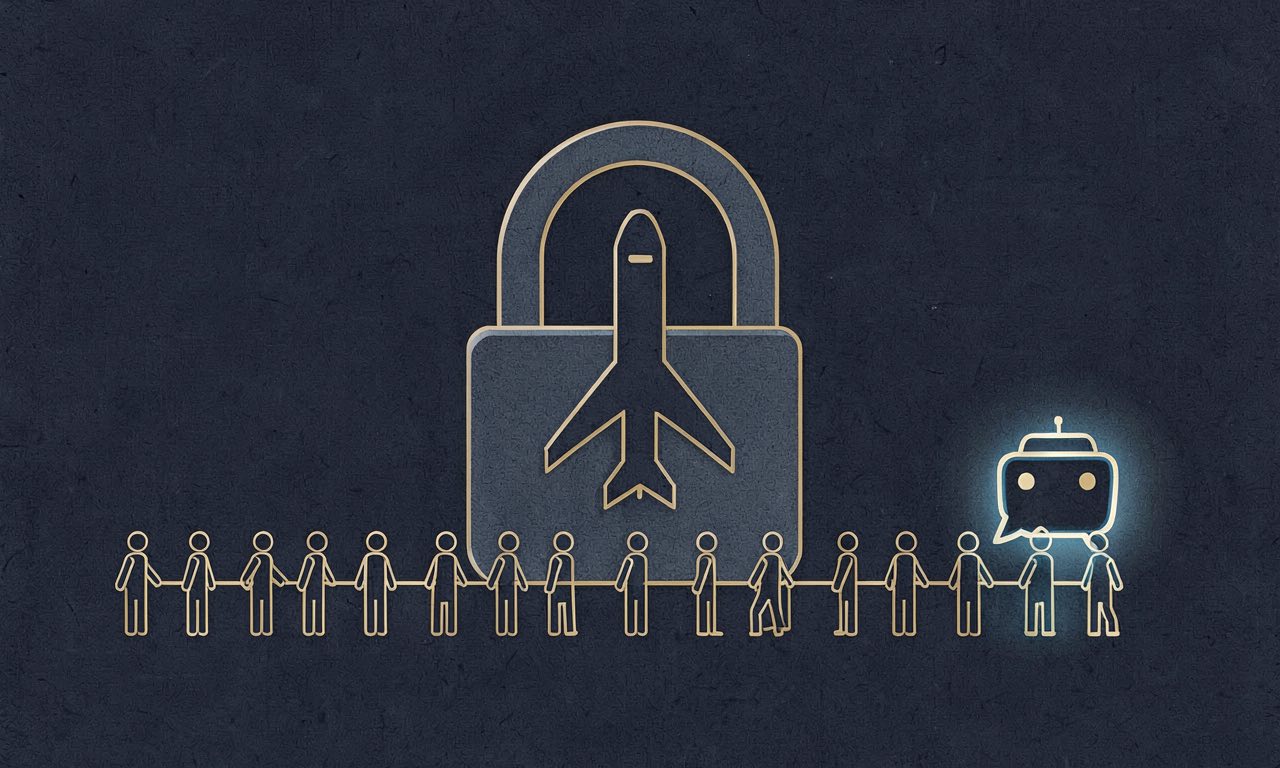
United Airlines has banned third-party AI agents from booking, modifying or servicing tickets on its platforms, as CBS News reported on Wednesday. The change is written into United’s contract of carriage — the legal terms every passenger agrees to — and blocks “any software or service… that takes autonomous or semi-autonomous action” to discover, search or book travel, whether or not a human supervises it, One Mile at a Time documented. Agents can still search flights and display prices; what they can no longer do is complete the transaction.
United’s stated reasons are safety and compliance. Sharing account credentials with “personal, third-party AI assistants can expose sensitive information”, the airline said, and agent actions “may result in unintended purchases, account changes, or use of MileagePlus miles” — the same concerns that led Amazon to block Meta’s Muse shopping agent in September. There is a regulatory layer too: PYMNTS reported United as saying automated check-in could violate FAA and DOT rules that require the passenger themselves to make mandatory disclosures — an AI agent cannot legally attest that a passenger’s luggage contains no prohibited items. Chief executive Scott Kirby, speaking at an industry event in Chicago, framed the concern as keeping AI intermediaries out of the relationship between the carrier and its customers, PYMNTS reported.
The ban is as much about data as about bookings
The pattern underneath is that airline bookings are a credential problem. An agent that can book a flight holds the passenger’s MileagePlus login, saved payment card and trip history at once — the same design flaw this site catalogued across six months of agent incidents: the credential is real, it is shared, and nothing about the protocol constrains what the agent does with it. United’s own framing lists “account changes” alongside purchases — which covers an agent reusing stored miles. Engadget also noted the airline wants no association with agent embarrassments like Meta’s Muse leaking a user’s home address as Engadget reported.
Notably, United is not blocking the channel where the money is contested — it is blocking the channel where the identity is. Agents may display United fares through aggregators like Kayak, Hopper and Google Flights; analyst Henry Harteveldt of Atmosphere Research Group told CBS News that consumers “shouldn’t find it any more difficult to find good fares”. What they lose is the ability to delegate the purchase itself, and United keeps the customer relationship — the thing airlines have fought online travel agencies over for two decades.
Peers are running the opposite experiment
The rest of the industry is split, which makes United’s move a live test. Delta permits authenticated AI assistants to book under safeguards for sensitive itineraries, while Southwest opened its inventory to ChatGPT users through a conversational plugin, CBS noted. The demand-side numbers, though, suggest everyone is fighting over a very small market: Uber disclosed this month that in a week of 320 million trips and orders, third-party AI agents booked four rides and about 500 Uber Eats orders, The Verge reported. “It is very, very early and very limited traction”, CEO Dara Khosrowshahi told analysts; his company notes an agent saves nobody time on a 50-second booking. One Mile at a Time’s read is blunter: United’s real motive is probably keeping agents from automatically repricing and comparing its fares — which is to say, preserving pricing power. That is United’s characterisation of its rivals, not ours, and Southwest’s and Delta’s differing policies make the strategic question genuinely unsettled.
Why it matters beyond airlines
Two forces just collided. Agent platforms are racing to embed checkout — OpenAI reportedly acquired travel-booking startup Odessia, and Meta has pushed Muse into shopping, PYMNTS reported — while the merchants who own inventory, starting with Amazon and now United, are answering with contractual bans. What distinguishes United’s move is the instrument: a contract of carriage binds every ticket purchased through an agent after the update, and gives United not just a technical block but a legal one. Stripe built agent payment rails and permissioning layers for the agentic web earlier this year; United’s answer is that for this category, the merchant simply says no.
For New Zealand the signal lands on our flag carrier’s doorstep. Air New Zealand’s booking stack faces the same agent wave, and the airlines’ split — Delta’s authenticated experiments against United’s ban — is the fork every local merchant with loyalty programmes and stored credentials will face this year. The economics also explain why bans may hold: agents barely drive volume yet, so refusing them costs almost nothing now, while conceding the customer relationship could cost plenty later. If agentic checkout grows, expect the ban-plus-negotiation dance; if it stays niche, United’s contract clause quietly becomes the industry default.
United has not disclosed enforcement details; Delta, Southwest and OpenAI did not respond to comment requests in the cited reporting.