A team led by Wei Gao, professor of medical engineering at Caltech, has shown that a fleet of light-activated nanorobots can do what decades of pharmacology has largely failed to do from the chemistry side: push meaningful quantities of drug across the blood-brain barrier. In a study published November 25 in Science Robotics, the so-called BrainBots delivered roughly five times more medication to the brains of glioblastoma mice than the same drug given intravenously — as Caltech reports in its newsroom.
“We showed that our BrainBots can carry medication through the bloodstream and help deliver it across the blood–brain barrier, one of the biggest challenges in treating brain diseases,” Gao said. The blood-brain barrier is the brain’s security perimeter — a lining of tightly packed cells along the vessels feeding the brain that admits oxygen and nutrients and blocks almost everything else, including, in therapeutic doses, most of the drugs clinicians would like to use against brain tumours. Glioblastoma, the most common brain cancer, has a median survival under two years, and a large part of the reason is that systemic chemotherapy simply struggles to arrive.
What the BrainBots actually do
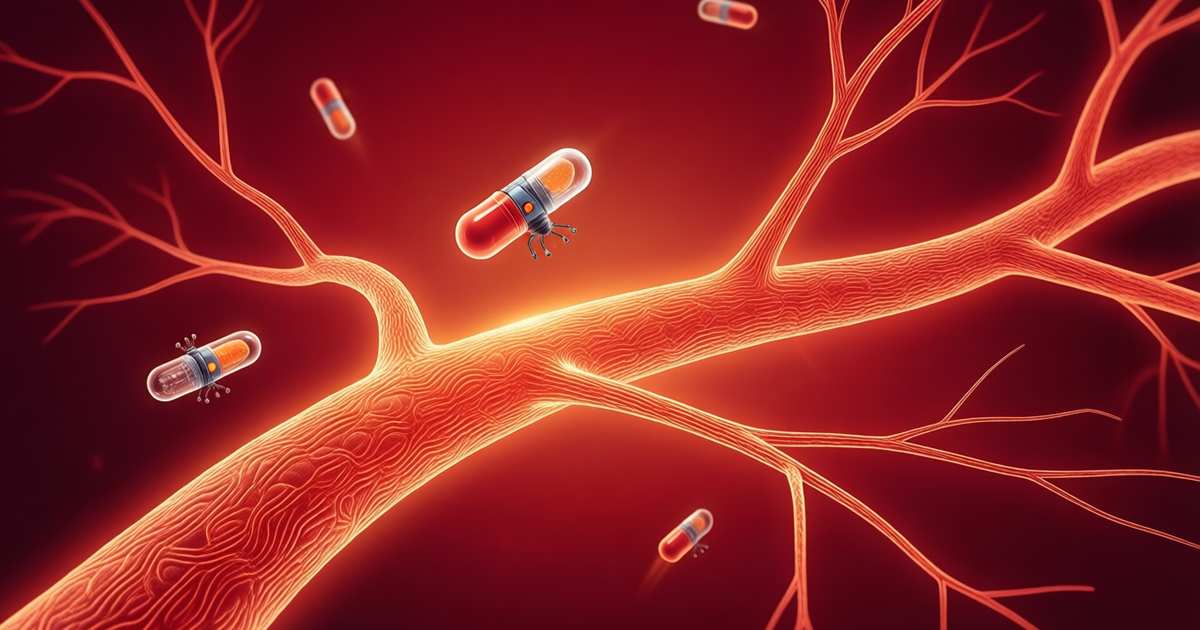
Each BrainBot is a capsule about 250 nanometres across — a few hundred times thinner than a human hair — with a balloon-like shape and a chamber of ammonium bicarbonate, a compound that turns to gas when heated, sealed inside a temperature-sensitive shell. Once injected into the bloodstream, near-infrared light shone through the skull heats any BrainBots circulating near the barrier. The shell melts, the ammonium bicarbonate fizzes into gas, and the pressure propels each capsule at the cells of the barrier wall. DNA aptamers on the surface latch onto those cells, which ferry the nanorobots across and into the brain, where the capsules fully degrade and release their payload. Inside Precision Medicine’s report describes the full mechanism, and notes the materials are established biodegradable, biocompatible ones rather than exotic new chemistry.
In mouse models of glioblastoma, BrainBots carrying the chemotherapy drug doxorubicin slowed tumour growth and extended survival, and did so without detectable disruption of the barrier itself — an important control, because older attempts to open the barrier, by ultrasound or osmotic tricks, trade safety for entry. Systemic toxicity was also lower than conventional doxorubicin dosing, meaning less of the poison ended up circling the rest of the body.
Gao’s surprise at how well it worked is worth quoting directly. “Because the BrainBots are so small and the blood circulation is so fast, we initially were not sure how much a method based on nanoscale propulsion would increase the passage of drugs through the BBB,” he said. “We are thrilled to see it worked so well.”
The honest caveats
Only a fraction of the injected BrainBots reach the brain; the rest degrade in the liver and spleen, as nanoparticle carriers generally do. Light delivery through the skull needs optimising, long-term safety and degradation remain open questions, and Gao himself notes that more research is needed before human studies. Five-fold improvement in mice is a result, not a treatment. Nobody is receiving BrainBots, and the glioblastoma patients who most need this work will wait years for trials even if everything proceeds cleanly.
Why this is a robotics story, not just a chemistry one
What makes the study notable for this site’s beat is the method. The team did not try to outsmart the barrier with a better molecule; they built active vehicles that sense their moment, propel themselves, attach, and complete the journey — sensing, actuation, navigation and docking, the classical robotics loop, at one quarter of a micron. That framing is spreading across medicine: UPenn’s artificially-grown muscle fibres gave a robot hand human-grade fine control, and regulators have started writing AI-enabled medical devices into the approval pipeline as a routine standard. The boundary between “drug” and “robot” is blurring, and the blood-brain barrier — the hardest wall in medicine — is where the blur got its strongest proof point.
The field around it is moving in parallel. Recent years have produced magnetically-steered nanorobots working in animal vessels, DNA-origami capsules that open in the acidic environment of tumours, and, in a 2025 Nature Communications study, neutrophil-carried nanomotors that crossed into glioblastoma tissue — a survey in the Annals of Medicine and Surgery reads the whole line of work as a shift from passive carriers to active ones. The BrainBots add light-controlled propulsion to that toolkit, and a demonstration that propulsion meaningfully beats diffusion at the barrier nobody could crack.
For readers tracking what robotics is becoming: this is the same discipline that empties delivery boxes at Erlangen and parks humanoid cells in factories, redirected at the bloodstream’s police checkpoint. The materials are biodegradable, the results are in a top journal, and the target disease has run out of better options. That combination is why the paper deserves attention well beyond the nanotech community. Gao is already looking past oncology: “Our new nanorobot is not limited to brain delivery, but we are trying to address one of the biggest problems in medicine — crossing the blood-brain barrier — as a starting point. We targeted cancer, but there are a lot of neurological diseases, such as Parkinson’s, for example, that we hope could benefit from this technology,” he said. As of publication, the finding is also being reported by Financial Times, The Telegraph and The Independent, all behind paywalls, so treatment specifics here lean on Caltech’s own account and Inside Precision Medicine’s.
Sources: Caltech, Science Robotics (10.1126/scirobotics.aef1928), Inside Precision Medicine; additional coverage in paywalled outlets: Financial Times, The Telegraph, The Independent, Chosunbiz.