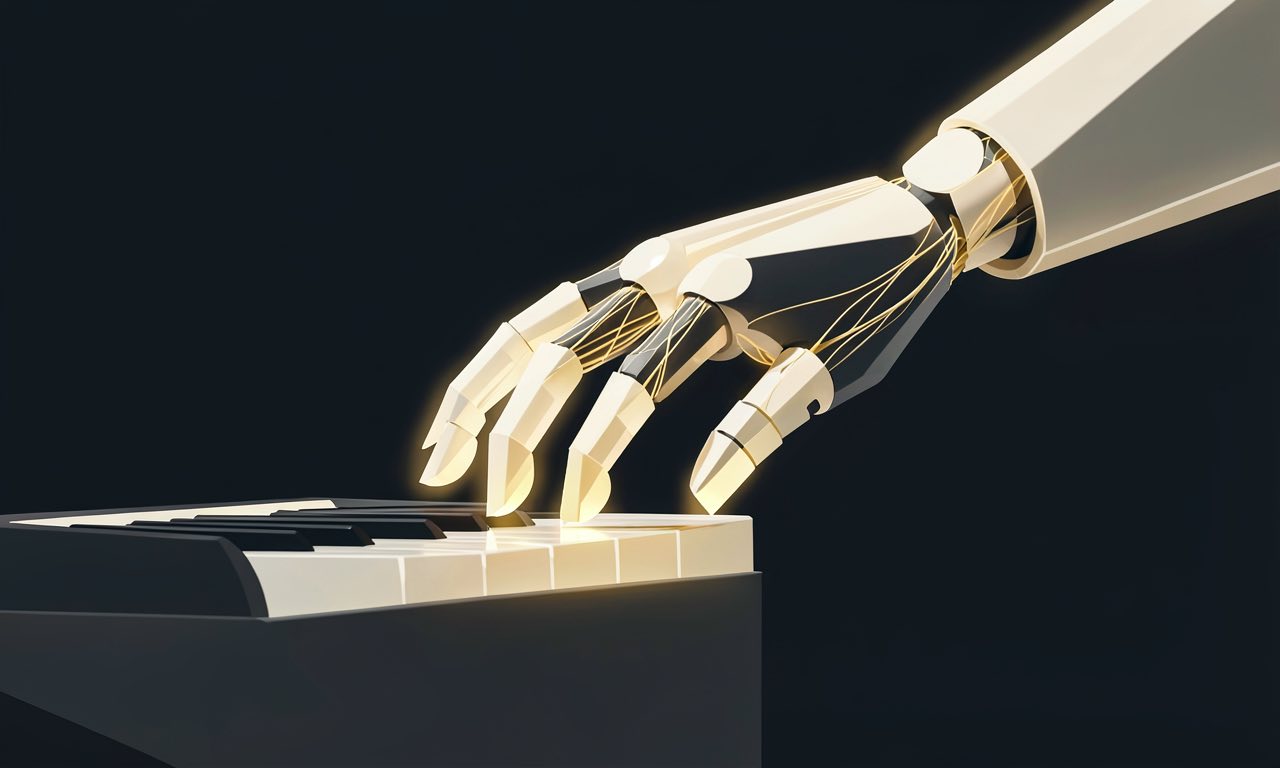
Engineers at the University of Pennsylvania have built an artificial muscle fibre that can hold a precise position by sensing its own temperature and contraction — no external sensors required — and demonstrated it by having a 3D-printed robot hand strike piano keys at different volumes while a set of artificial eyes tracked a gaze. The work, published this week in Advanced Functional Materials and covered by Popular Science, targets the exact gap between what today’s humanoids can do and what their actuators can feel.
🔍 THE BOTTOM LINE
Humanoids can dance and backflip because their motors are big; they still fumble delicate work because rigid actuators cannot feel their own position the way muscle does. A fibre that is simultaneously heater, sensor and muscle — self-sensing, without separate feedback hardware — is the kind of unglamorous component that decides whether robots ever move from showreels to hands.
The problem: strong or precise, rarely both
“Soft robotic muscles need to be both strong and flexible to mimic human movements, but these properties are rarely found in the same material,” lead researcher Shu Yang told Penn Engineering. The team’s answer braids three materials into one fibre: liquid crystal elastomers (LCEs), rubber-like polymers that contract and stretch with heat, provide the movement; graphene toughens and softens the fibre so it survives opposing muscles pulling in other directions; and an ultrathin embedded copper coil does two jobs at once.
That coil is the clever part. LCEs misbehave when heated — they stretch, keep contracting, then creep back toward their original length as they cool, which ruins any attempt to hold a subtle position. The Penn team used the coil’s electrical resistance as a real-time temperature gauge, adjusting heating power continuously to pin the muscle at its target position. “Because the coil served as both a heater and a sensor, we did not need a separate sensor for feedback,” Ph.D. student Xuelin Wu told Penn Engineering.
What the demos actually showed
The demos were deliberately small and fine. A robot hand fitted with the fibres pressed piano keys at varying intensities — dynamic control, not just contact — and a set of artificial eyes held a moving gaze steady, the sort of hold-in-place behaviour that defeats actuators which overshoot and settle. Both are benchmarks of fine coordination rather than force, drawing on “the small muscles in human eyes and fingers” that the team says inspired the design.
It is tempting to file this under humanoid-robot spectacle, but the honest read is the opposite: this is the slow, unglamorous half of the robotics project that gets skipped while videos go viral. Bipedal robots have been walking factory lines and needing human supervisors on night shift — impressive locomotion paired with manipulation that still breaks on edge cases. The muscle-tendon systems doing the gripping remain the weak link, a point this site has made before about the gap between organic tissue and robot actuators. A fibre that self-monitors contraction in real time is a component-level fix for exactly the failure mode where a grip task degrades because the actuator cannot tell how hard it is pulling.
Why self-sensing matters more than the piano
Conventional robots bolt separate position sensors onto every joint, adding weight, wiring and failure points. Actuators that know their own state shrink the control problem at its root: if a muscle fibre closes the sensing loop internally, robots get finer control with less hardware, and the coordination layer above it gets simpler. It is the same lesson the orbital-assembly world learned when Caltech’s ASTRA built a structure in space by keeping the mechanism simple and self-verifying — capability that survives contact with the real world comes from components that check themselves, not from more elaborate choreography.
The road to a real hand is long: the demo hand is 3D-printed, the muscle fibres are driven by external heating power, and nothing here claims force density to rival electric motors. But the pattern is established — LCE-plus-sensor co-design, verified across two very different acts of precision. The team’s next steps, per the Penn release, run toward coordinating many fibres together, which is where a whole hand of these fibres starts to look like a tendon network.
FAQ
What is the artificial muscle made of? Three components in one fibre: a liquid crystal elastomer that contracts and stretches with heat, graphene for toughness, and an embedded ultrathin copper coil that acts as both the heater and the feedback sensor.
Why does it matter that the coil is both heater and sensor? It removes the separate position-sensing hardware conventional robots need at every joint. The muscle knows its own state from its own resistance, so the control loop needs less equipment to hold a precise position.
Did the robot actually play piano? It pressed individual keys at different intensities — a demonstration of graduated force and steady hold, not a performance. The same fibres also drove artificial eye movements that held a gaze.
🔍 THE BOTTOM LINE
The humanoid race gets its headlines from walking, but the hiring decisions get made on gripping. Self-sensing muscle fibres attack the bottleneck below the spectacle level: an actuator that knows where it is, holds position without drift, and needs no external feedback gear. Piano keys today; the demo is a clean, low-cost proof that the sensing loop can live inside the muscle itself.
The study was published in Advanced Functional Materials this week; both demos were run by Penn Engineering and independently described by Popular Science on 15 November. The fibres remain lab-scale — no commercial or production timeline was announced in the university release.