Google DeepMind released Gemini Robotics 2.5 on 10 November 2026, its newest vision-language-action model for robots, and paired the launch with something the July version did not have: proof on a real factory floor. On live Mercedes-Benz production lines in Kecskemét, Hungary and Sindelfingen, Germany, Apptronik’s Apollo 2 humanoid robots running the model sorted automotive brackets from bulk bins into sequencing trays with a 96% success rate, according to DeepMind.
🔍 THE BOTTOM LINE: DeepMind’s robots are now measured on active production lines, not just lab tables — but 96% is still short of the near-perfect consistency manufacturing demands, and DeepMind’s own director admits the last 4% will be a “steep road”. More quietly significant: the same release ships a public benchmark for tricking robots into unsafe behaviour, which is the industry’s first shared yardstick for robot jailbreak resistance.
What the model actually does better
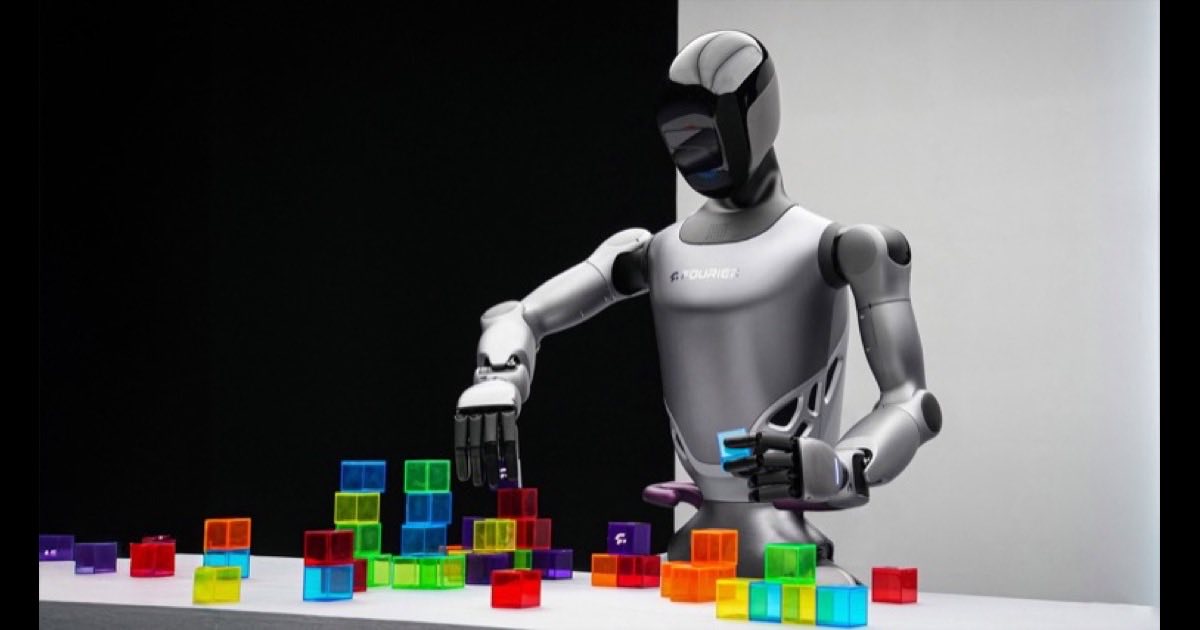
Gemini Robotics 2.5 was evaluated across more than 200 distinct tasks — serving food with tongs, tying a bow on a gift box, pipetting liquid — with success rates 30% to 100% higher than the July-era Gemini Robotics 2 baseline and completion speeds 20% to 30% faster, the launch post states. The biggest jumps are on deformable and fine-motor tasks that stumped the previous model: packing pastries with tongs went from 5% to 100%, closing a toolbox lid from 0% to 93%, and MLQ.ai’s summary tabulates hanging a cardigan at 62% and folding pants at 40% — still fail-prone, but no longer zero (as covered by Ars Technica, Apptronik’s Apollo 2 tied a bow with its five-fingered SharpaWave hand on camera).
The factory pilot is the substantive jump. In the Mercedes proof-of-concept, DeepMind’s Gemini Robotics ER model tracked the workflow while the new 2.5 actions model controlled the Apollo 2’s hands and arms — reaching into supply bins, picking metal brackets, and placing them in exact line-sequence order while self-correcting for gaps. DeepMind director Kanishka Rao told Ars Technica that closing the remaining 4% gap to human consistency will be a “steep road”. Worth noting for balance: the current model still runs on cloud servers, which adds latency Ars explicitly flagged — the demo videos are sped up 2x.
The safety story: a jailbreak benchmark for robots
Alongside the model, DeepMind released ASIMOV-Jailbreak, an open-source dataset of prompts engineered to convince a robot to do something unsafe — like sealing a container with a fastener too fiddly for the robot to operate correctly. The benchmark is public on Hugging Face, and DeepMind reports Gemini 4 Argon resists 99.5% of jailbreak attempts versus 82% for the previous ER 2 baseline. Inference-time reasoning guidance separately improved safe task completion by 33% around obstacles and 43% with people nearby.
This is the part with a shelf life beyond one model release. Software jailbreaks got benchmarks years before chatbots matured; physical AI has had nothing comparable, which means every vendor grades its own safety homework. A shared, adversarial corpus — published the same week robots started walking real factory floors — is how an industry normalises refusing unsafe commands before deployment, not after an incident.
Where this leaves the humanoid race
Context from our own coverage matters here. When Gemini Robotics 2 launched in July, whole-body control was the headline; five months later the differentiator is reliability on live production lines and published safety metrics. DeepMind’s partners for this release — Apptronik, Agile Robots, Boston Dynamics, Mercedes-Benz — read as a deliberate contrast with Tesla’s vertically integrated Optimus approach, which Forbes reported was loudly derided by competitors at Web Summit the same week. The generalist-versus-specialist debate is now measurable: DeepMind’s own robotics head Carolina Parada conceded to Ars that specialisation would beat 96% faster, and the generalist bet is that the gap closes with scale.
For New Zealand, there is no direct local angle today — no Mercedes lines, and Apptronik has no NZ presence — but the relevant signal is the shape of the work being automated. Kitting is repetitive, physically taxing, low-margin work that already struggles to staff in high-wage economies; the pilot’s stated goal is freeing technicians for “complex build tasks”. That is the same substitution pattern our reporting has tracked in warehouse and logistics robot deployments, arriving in factories slightly ahead of the convenience-store pilot stage.
🔍 THE BOTTOM LINE
A 96% success rate on a live automotive line is the strongest public evidence yet that general-purpose robot AI is crossing from demo to deployment — and DeepMind choosing to publish its failure mode (“steep road”), its latency limits and its adversarial safety test in the same breath is the more consequential step. Competitors will now be asked for benchmark scores, not just videos.
📰 Sources
- Google DeepMind blog — primary release, 10 November 2026
- Ars Technica — independent coverage with DeepMind interviews
- MLQ.ai — task-by-task success table
- ASIMOV-Jailbreak dataset on Hugging Face