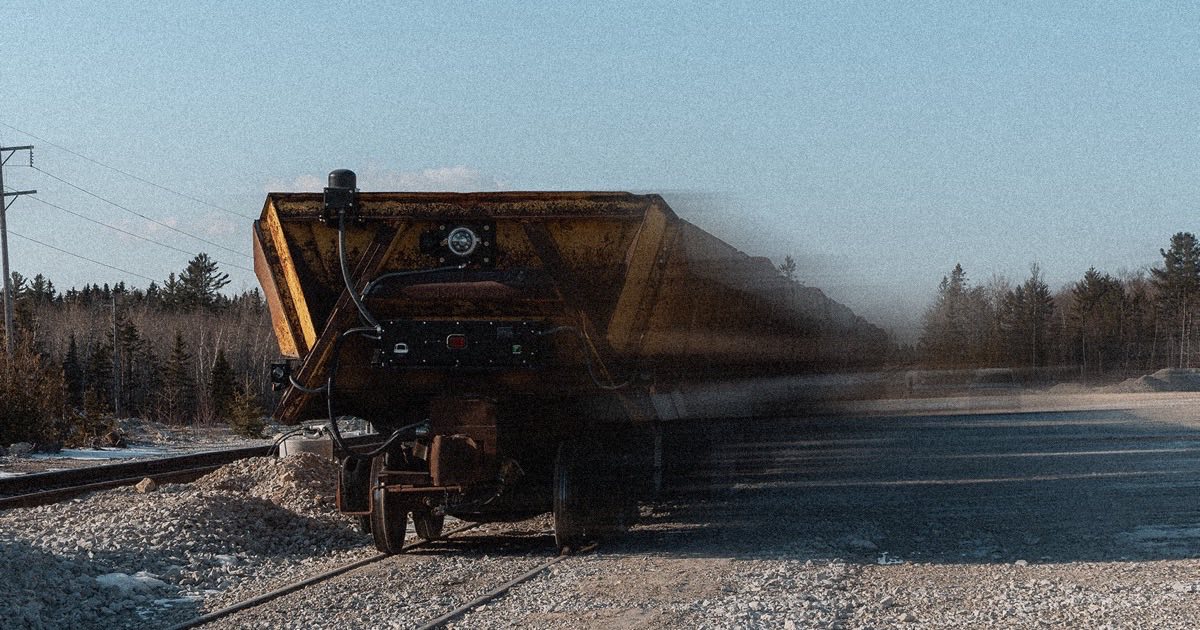
Autonomous freight railcars are getting their second customer site, from the customer who gave them the first one. Intramotev, the St. Louis-area company building self-propelled freight railcars, has announced a new agreement with Watco — one of the largest short line railroad holding companies in North America — to deploy its TugVolt technology at a second site: an industrial facility in Seadrift, Texas, per Robotics & Automation News. The expansion builds on the companies’ existing work at Watco’s terminal in Wood River, Illinois.
The first site did the talking
What makes this announcement more than a press release is what the first deployment has been doing. At Wood River, TugVolt units are in revenue service switching railcars for Watco’s customers — moving soda ash, according to Intramotev’s own materials. Across production operation, the company says the technology has moved more than 650,000 tons of material and more than 9,000 carloads. Those are revenue-service numbers, not pilot-programme numbers, and in industrial autonomy they are the only numbers that matter.
Watco’s decision to expand — rather than pause, audit and rethink — is the quiet headline. Aaron Jensen, the company’s senior vice president of operations solutions and support, said the Wood River deployment “showed us that TugVolt can deliver safe, reliable car handling and fit into our existing operations,” calling Seadrift “the next step in putting this technology to work across our network.”
Tim Luchini, Intramotev’s CEO, said his company was “grateful to have earned Watco’s trust at Wood River, and proud they’ve chosen to expand with us to Seadrift,” and promised “the same flexibility, safety and cost savings for their customers.”
A busy year, itemised
The agreement caps a genuinely eventful 2026 for a company that first put a driverless railcar on working track only a couple of years ago. Intramotev announced a deployment deal with R.J. Corman in Kentucky in March. In April came an agreement with Austria’s national railway operator. In June, US Army Reserve soldiers trained on TugVolt units during a planned technology assessment. And in October, the Federal Railroad Administration selected the City of Columbia, Missouri, for a $16.2 million grant that will put TugVolt technology to work there as well. Intramotev claims deployments today in Missouri, Illinois, Michigan and Austria, and says it is the first company in the world to commercially deploy autonomous freight railcars.
Read together, those are four different kinds of customer — a short line operator, a national railway, an Army Reserve unit, a city — adopting the same core product: a battery-electric railcar that can move, switch and spot other cars without a locomotive or a crew on board. We noted the general shape of this pattern earlier this year: autonomy keeps arriving in operations faster than the oversight frameworks around them mature, and shunting is turning out to be one of the places the gap closes quietly rather than controversially.
Why rail yards keep getting autonomy first
There is nothing accidental about the sequence. Autonomous switching lives in a bounded, repetitive, privately controlled environment: fixed tracks, known car types, low speeds, no kids on e-scooters and nothing to swerve around. It is the same reason wheeled robots — not humanoids — are the machines factories actually buy, a pattern the World Robot Conference made hard to miss. Remove the hardest physical AI problems from the environment and the remaining problem — reliable perception of railcar couplers and switches in weather — is tractable with today’s sensors.
The commercial logic is straightforward too. A short line or an industrial siding that runs a locomotive for a handful of daily moves burns a full diesel crew’s worth of cost on what is mostly standing still. A self-propelled battery car converts that to a scheduling problem. That is also why the customer expansions matter: each additional site multiplies the runtime data behind the same software stack, the classic industrial-autonomy flywheel — and consolidation of exactly this kind of industrial autonomy is the direction the big automation firms are already moving.
For New Zealand, nobody has announced anything locally, and KiwiRail’s network is a different animal from a North American short line. But the country’s industrial sidings — log yards, dairy plants, port exchanges — are precisely the low-complexity, high-frequency shunting environments this technology targets, and the rail sector here has the same decarbonisation and crewing pressures that make battery-electric switching attractive. Watch whether a trial shows up at an industrial terminal before it does on the mainline; Intramotev’s whole expansion history suggests that is the order it happens in.
Seadrift’s timeline was not disclosed in the announcement. As of publication, neither company had released the deployment schedule or the commercial terms of the agreement.
Further reading: autonomy arriving ahead of assurance, why wheeled robots keep edging out legged ones, and Rockwell’s move to consolidate industrial AMR fleets. This story was also covered on November 20 by the American Journal of Transportation and Railway Age.