Four stories published on this site this morning, and none of them is about a new model. OpenAI bought the code-review layer, a Xiaomi humanoid logged an eight-hour factory shift, KPMG’s CEOs said they will train rather than cut, and NZ Police axed the unit whose work was easiest to check. One current runs beneath all four.
🔍 THE BOTTOM LINE
The AI economy is consolidating around one column of the ledger: verification. The infrastructure deals prove it (OpenAI), the operating metrics prove it (Xiaomi), and the first labour-market verdicts — KPMG’s 89 percent, Police’s cheapest-to-check cuts, Upwork’s shrinking core — all point at work organised around proving what a machine did, not showing what it can do.
Why an agent lab bought a review desk
OpenAI’s acquisition of Pierre Computer (as we covered) looks small until you read what it owns: the Trees and Diffs libraries inside Codex, plus a Git storage service pitched as “designed for machines”. Days earlier, OpenAI published Pando, an in-house source-control backend it says was “built with Codex in 10 weeks” because agent-generated commits were buckling traditional Git. Meanwhile the DeepSeek camp open-sourced an agent built mostly by agents, as we covered in Monday’s DSH piece.
The deep pull behind this section: OpenAI’s own Codex repository on GitHub now shows 133,182 stars and a last commit pushed hours before this piece was written, per the public repository — the busiest agent codebase on the planet is itself evidence that generated code volume, not model quality, is the binding constraint. When machines are the main committers, the valuable surface shifts from generating work to versioning, reviewing and auditing it.
This is the market pricing last week’s thesis: the scarce, well-paid work is checking the machine, as we argued in the verification premium. The wage thesis just got an acquisition order.
Hours, now, are the benchmark
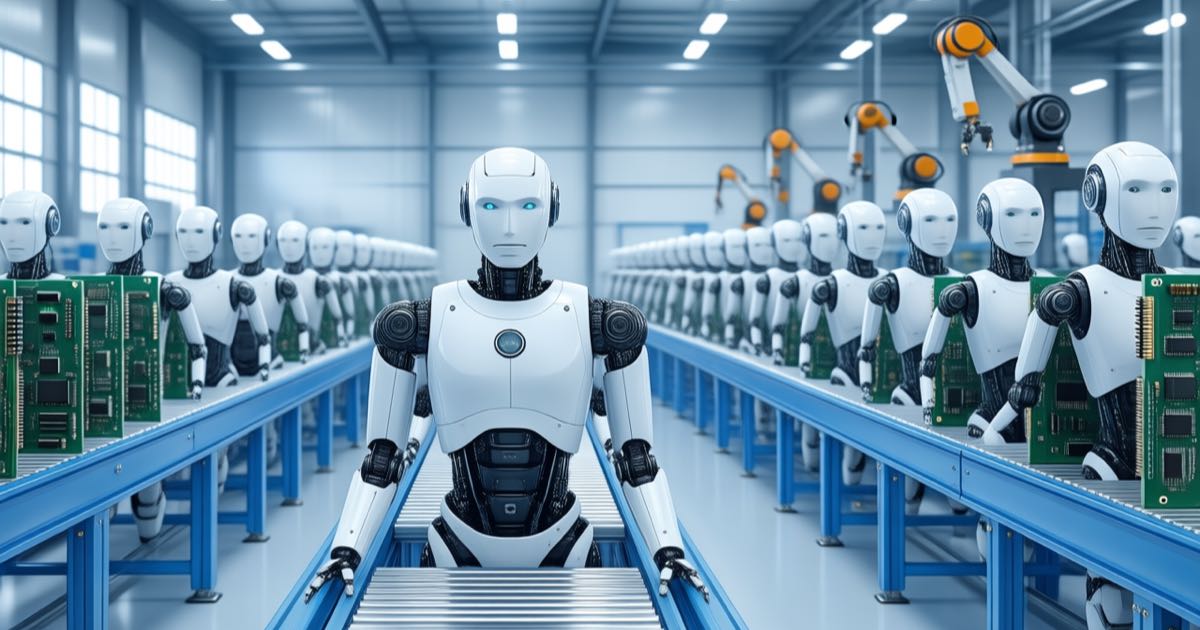
Xiaomi’s humanoid sorted car parts for eight hours straight, and the company’s own X post shows what mattered: no handlers, no tether, no cut at hour six. Interesting Engineering’s write-up flagged the missing throughput figures — but duration itself is the shift. Factory managers, unlike demo audiences, price uptime. That is why our Xiaomi analysis read the video as checkpoint two of a public ladder: short demo, then a shift, then multi-robot coordination, then scale toward Lei Jun’s five-year plan, as CNBC chronicled.
The western bracket is behind on the same axis. Agility cleared its Nasdaq listing last week on the promise of exactly these line jobs, and AgiBot made productivity-per-hour its headline metric in September’s coverage. The industry’s proof point has moved from “look what it can do” to “look how long it worked” — duration is a verification claim: sustained, auditable behaviour has replaced spectacle.
The labour market is refreezing around the same column
Three labour datasets crossed this site in three days, and all three break the same way. Stats Canada found no broad evidence AI is displacing young hires; LinkedIn counted 2 million AI job postings with entry-level AI engineer hiring up sharply this week’s brief; and this morning KPMG’s global CEO survey put 89 percent of CEOs expecting headcount growth within three years, with 46 percent funding reskilling programmes, per the full survey and our analysis. The two-hiring-margins pattern we tracked in October keeps widening.
NZ Police’s restructure shows where the cuts actually land. Twenty-four file-management jobs went in October; transcription — the unit that feared Whisper most since 2024 — was largely spared, because court-grade output must be checked by a human, as RNZ reported. Where verification is expensive, humans stay. That is our Police analysis in one line: AI-adjacent cuts follow accountability lines, not automation lines.
The squeezed row of the table is the marketplace: Upwork’s Q3, out this week, had revenue down 8 percent year-over-year to $185.6 million and gross services volume down 10.1 percent to $914.1 million, even as net income rose 8 percent to $31.8 million, per StockStory’s breakdown. The middle of the table — humans matching humans for gigs — is where automated matching bites first, and the platform knows it, steering its own AI product launches to survive the mix shift.
The line that decides the next two years
Draw the table and the direction is plain. Work whose output is expensive to verify concentrates (court transcripts, deployed code, factory uptime); work that is cheap to verify restructures first (file routing, basic matching); work with no verification layer at all gets repriced or absorbed outright. Companies acting on this — OpenAI buying the audit layer, Xiaomi publishing hour counts, CEOs funding verification-shaped training — are making the same bet: in an AI economy the scarce skill is not producing output but guaranteeing it.
For NZ readers the practical read is unglamorous. Back-office restructures like Police’s will keep landing where output is cheap to check, so the leverage sits in roles that own accuracy, sign-off and audit trails — the polytechnic short courses and employer programmes inside KPMG’s 46 percent are aiming there. And sole traders who sell through marketplaces should watch listing platforms’ take-rates closely: agent-mediated matching squeezes that row first.
❓ FAQ
What is “the checked column”? It is shorthand for work organised around verifying AI output — code review, court-grade transcription, uptime logging, audit trails. OpenAI’s Pierre acquisition, Xiaomi’s 8-hour shift and NZ Police’s spared transcription unit all sit in it.
Did Upwork’s revenue fall because of AI? Upwork’s Q3 revenue fell 8 percent year-over-year, per StockStory. Analysts have linked marketplace pressure to AI disruption and search-algorithm shifts; the platform’s own response is pivoting its products toward AI-assisted hiring. Attribution is contested, the direction is not.
Is an 8-hour robot shift proof humanoids are ready for real work? It is proof of endurance, the axis factory managers actually price, as our Xiaomi coverage notes — but Xiaomi published no throughput or intervention figures, so it remains a milestone, not a benchmark.
What does this mean for NZ workers? Verification-owning skills — review, quality sign-off, audit trails — are where hiring and budgets are heading, per KPMG’s survey and Police’s spared court transcription unit; cheap-to-check back-office work is where cuts land first.
🔍 THE BOTTOM LINE
Two years ago the argument was whether AI works. This week’s receipts answer a different question: who can prove what it did. The companies and institutions acting like proof is the product — OpenAI buying the review desk, Xiaomi publishing hours instead of tricks, CEOs funding training rather than cuts — are betting the scarce skill in an AI economy is guaranteeing output, not generating it. Watch the checked column; the next two years of AI work get decided there.
📰 Sources
- KPMG 2026 Global CEO Outlook
- RNZ (NZ Police restructure reporting)
- OpenAI engineering blog (Pando / scaling Git)
- Interesting Engineering (Xiaomi humanoid)
- StockStory (Upwork Q3 deep dive)
- Unite.AI (OpenAI–Pierre analysis)
- CNBC (Xiaomi factory trials)
- GitHub API (openai/codex repository)